
Blog
Do You Need a Qualified Appraisal for Your Equipment Donation?
Equipment donations over $5,000 trigger the IRS's qualified appraisal requirement under IRC Section 170(f)(11), and a dealer trade-in quote or internal estimate won't satisfy it. This guide breaks down the dollar thresholds, timing rules, and appraiser qualifications that separate a compliant deduction from a denied one.
Donating a piece of equipment to a qualifying charity can generate a meaningful tax deduction, but the IRS does not take your word for what it's worth. Once the claimed deduction crosses $5,000, federal tax law requires a qualified appraisal for the equipment donation, prepared by a qualified appraiser, not an internal estimate or a dealer's trade-in quote. This guide walks through the dollar thresholds, the timing window, and the specific requirements that separate a compliant appraisal from paperwork the IRS will reject, and where our equipment donation appraisal service fits into that process.
What Is the $5,000 Threshold for Equipment Donations?
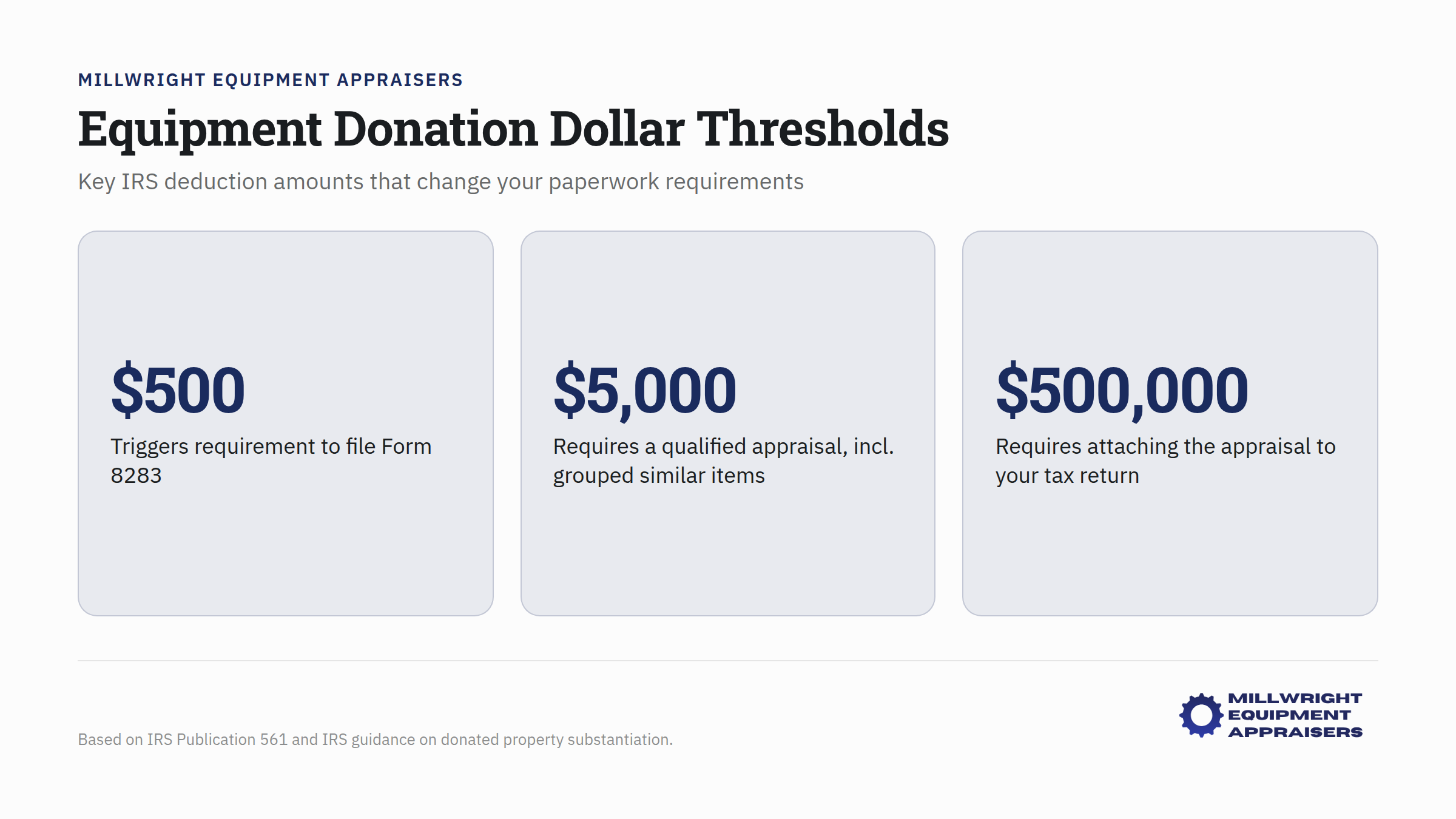
If the claimed deduction for a single piece of equipment, or a group of similar equipment items, exceeds $5,000, you must obtain a qualified appraisal made by a qualified appraiser. This rule comes directly from IRS Publication 561 and is echoed in IRS guidance for donated property substantiation.
Below the $5,000 mark, the requirements are lighter but not nonexistent. Any noncash donation over $500 still requires Form 8283, and our guide on what the IRS rule for donations over $500 actually requires covers that lower tier in detail. The $5,000 threshold is the point where a signed, qualified appraisal becomes mandatory rather than optional documentation.
The grouping rule catches a lot of donors off guard. The $5,000 threshold applies to a single item or to a group of similar items donated in the same tax year, even if no individual piece crosses $5,000 on its own.
Example: A manufacturer donates 8 identical CNC workstations to a trade school in one tax year. Each unit is worth $900 on its own, well under $5,000. But because they're similar items donated in the same year, the IRS treats the group's combined value, $7,200, as the relevant figure, and a qualified appraisal is required.
Whether the deduction is even allowable in the first place is a separate question worth confirming before you get to the appraisal stage; our answer to whether donating equipment is tax deductible covers the underlying eligibility rules.
What Makes an Appraisal "Qualified" Under IRS Rules?
A qualified appraisal is a specific legal document, not just a written opinion of value. It must be prepared by a qualified appraiser, dated within a defined window, free of any fee tied to the appraised value, and it must contain a specific set of facts about the equipment and the valuation method used.
Timing. The appraisal must be dated no earlier than 60 days before the date of the contribution. You must then receive the completed appraisal before the due date, including extensions, of the tax return on which you first claim the deduction. If you claim the deduction on an amended return instead, the appraisal must be in hand before you file that amended return.
Who qualifies as the appraiser. Under the regulations governing qualified appraisers, an individual generally must:
- Have earned a recognized appraisal designation, or otherwise have verifiable education and experience valuing the specific type of equipment being appraised.
- Regularly perform appraisals for compensation, rather than issuing one as a one-off favor or side task.
- Have no financial stake in the transaction. An appraiser who is the donor, the donee, a party who sold the equipment to the donor, or anyone related to those parties, does not qualify.
- Charge a flat, fixed fee for the report. No part of the fee can be based on a percentage of the appraised value.
Required content. The appraisal document itself has to include, at minimum, a description of the equipment specific enough that someone unfamiliar with it could confirm the appraised item is the donated item, its physical condition, the date of contribution and the date of the appraisal, the appraised fair market value, the valuation method used (sales comparison, cost, or income approach), and the specific basis for the conclusion, such as comparable equipment sales. These content requirements trace back to Treasury Regulation 1.170A-13, and the appraiser must also disclose their qualifications and sign and date the report.
Pro tip: Ask any appraiser you're considering whether they follow the Uniform Standards of Professional Appraisal Practice (USPAP), published by The Appraisal Foundation. USPAP compliance is the industry benchmark for a defensible report and is the standard our appraisers follow on every equipment donation engagement.
Qualified Appraisal vs. Dealer Quote: What's the Difference?
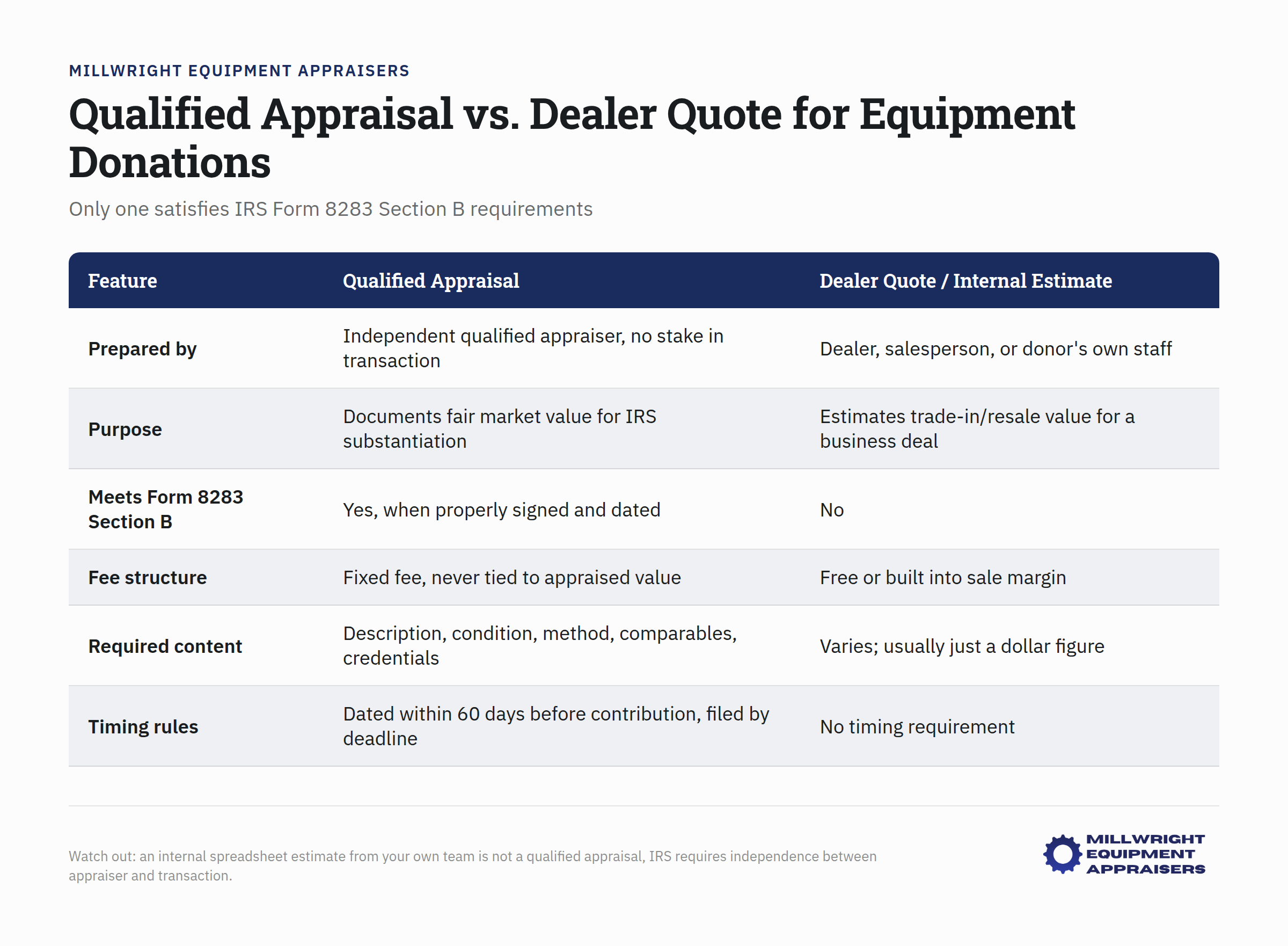
A qualified appraisal and a dealer trade-in quote answer different questions for different audiences, and only one of them holds up to an IRS review. A trade-in quote reflects what a specific dealer is willing to pay that day, discounted for their own resale margin and inventory needs. It is not an independent, documented opinion of fair market value, and it will not satisfy Form 8283's Section B requirements no matter how detailed the quote sheet looks.
| Feature | Qualified Appraisal | Dealer Quote or Internal Estimate |
|---|---|---|
| Prepared by | Independent qualified appraiser with no stake in the transaction | Dealer, salesperson, or the donor's own staff |
| Purpose | Documents fair market value for IRS substantiation | Estimates trade-in or resale value for a business transaction |
| Meets Form 8283 Section B | Yes, when properly signed and dated | No |
| Fee structure | Fixed fee, never tied to the appraised value | Free or built into a sale margin |
| Required content | Description, condition, valuation method, comparable data, appraiser credentials | Varies; usually just a dollar figure |
| Timing rules | Dated within 60 days before contribution, received by filing deadline | No timing requirement |
Watch out: An internal spreadsheet estimate from your own accounting department, even if it's careful and well-researched, is not a qualified appraisal. The IRS requires independence between the appraiser and the transaction. A number your own team generates does not meet that bar.
The $500,000 Rule: When You Must Attach the Appraisal
Most donors only need to keep the qualified appraisal on file, not submit it with their return. That changes once the claimed deduction for a single item or group of similar items exceeds $500,000. At that level, IRS Publication 561 requires you to attach the full qualified appraisal report to your tax return, not just Form 8283.
For most equipment donors this threshold never comes into play, but it matters for large fleet donations, industrial machinery lines, or aggregated donations of similar high-value assets in a single tax year. If your donation is anywhere near this range, plan on the appraisal report itself becoming part of your filed return, and budget the extra time for your CPA to review it alongside the rest of your filing.
What Happens If You Skip the Appraisal?
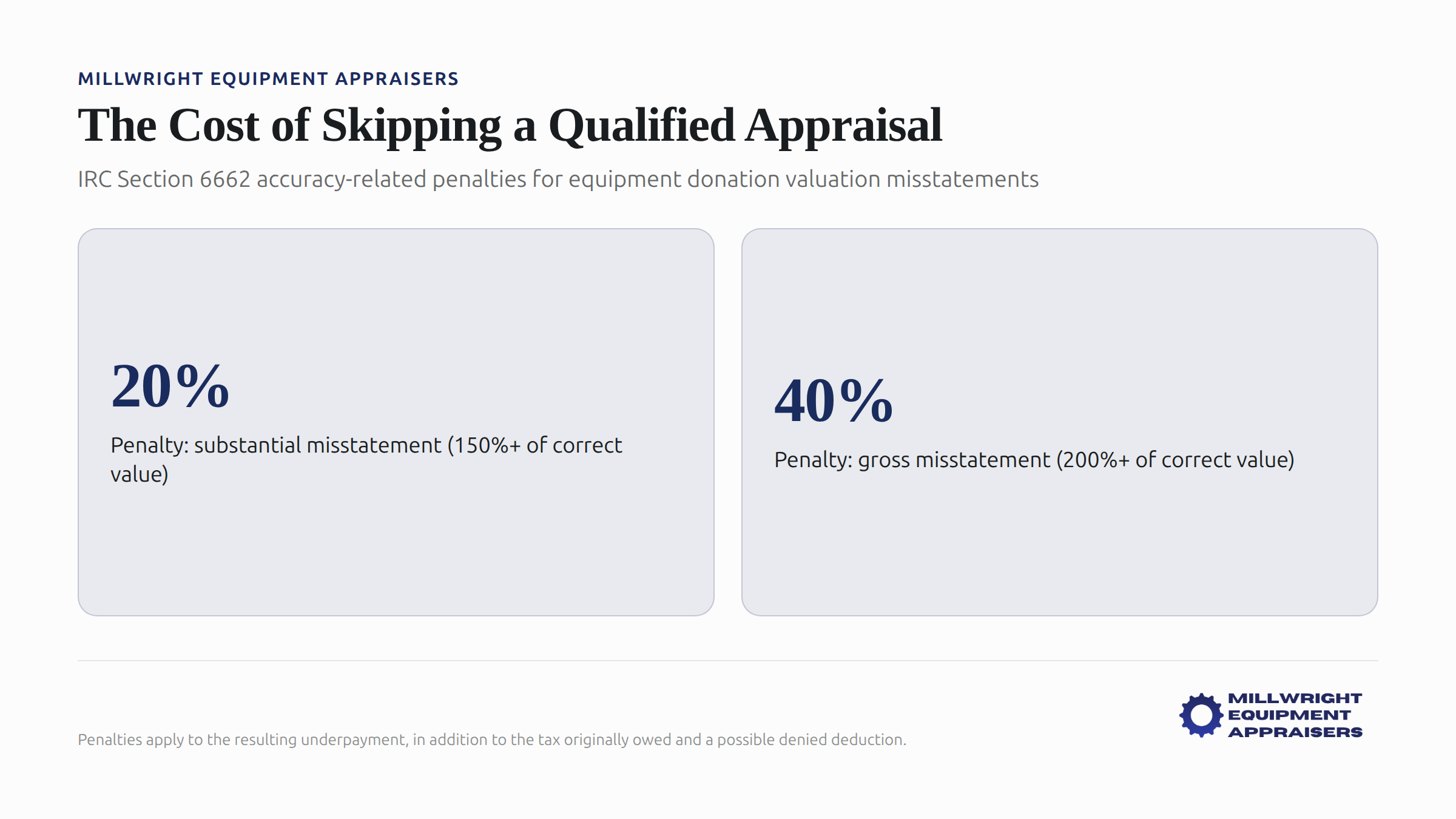
Skipping the qualified appraisal requirement doesn't just risk losing the deduction. It can trigger an accuracy-related penalty under IRC Section 6662 for a substantial or gross valuation misstatement. A substantial valuation misstatement (generally, claiming a value at 150% or more of the correct amount) can add a 20% penalty on the resulting underpayment. A gross valuation misstatement (claiming a value at 200% or more of the correct amount) raises that penalty to 40%.
Key takeaway: The appraisal fee is a small cost next to the exposure of a denied deduction plus a 20% to 40% penalty on top of the tax you owed in the first place. A properly documented, qualified appraisal is what stands between a donor and that outcome.
Form 8283 Section B: The Appraiser's Signature Requirement
Equipment donations that require a qualified appraisal get reported in Section B of Form 8283, not Section A. The Form 8283 instructions are explicit that items reportable in Section B require a written qualified appraisal completed before you fill out that section, and the form itself requires the appraiser's signature and the receiving charity's signature (donee acknowledgment) before it's valid.
Missing either signature is one of the most common reasons a deduction gets challenged. The appraiser signs to certify the valuation; the donee signs to acknowledge receipt of the property described. Neither signature substitutes for the other, and both need to be in place before the return goes out the door.
Getting an Equipment Donation Appraisal Done Right
The $5,000 threshold is the line that separates a simple receipt from a qualified appraisal requirement, and the details around timing, appraiser independence, and required content are exactly where donor-prepared documentation tends to fall short. Our appraisers hold credentials with organizations such as the American Society of Appraisers (ASA), the Certified Appraisers Guild of America (CAGA), and NEBB, and every equipment donation report we prepare follows USPAP and is built to satisfy Form 8283 Section B from the start. Fees for these engagements are quoted as a fixed amount after we scope the specific equipment, the number of assets involved, and the intended use of the report; they are never billed hourly and never tied to the value we conclude.
If you're weighing a deduction near the $5,000 mark or preparing for a larger equipment donation, our equipment donation guides and FAQ library cover the related documentation questions in more depth, and you can request an appraisal to get the process started.
This article is provided for general informational purposes only and does not constitute legal, tax, or financial advice. Readers should consult a qualified attorney or CPA regarding their specific circumstances.