
Blog
What Records You Need to Document an Equipment Donation for Taxes
Documenting an equipment donation for taxes means matching the right paperwork to your deduction amount, from a basic receipt under $250 to a qualified appraisal above $5,000. This checklist walks through exactly what the IRS expects at each dollar threshold.
Donating a forklift, a CNC machine, or a fleet of shop tools to a school or nonprofit can produce a meaningful tax deduction, but only if the paperwork matches the dollar amount you're claiming. The IRS ties documentation requirements to specific thresholds, and missing one step, like a signature or a filing deadline, can put the entire deduction at risk. This checklist walks through exactly what to keep at every level, from a simple receipt to a full qualified appraisal.
If you're weighing whether your equipment donation needs professional valuation support, our equipment donation appraisal team can tell you where your gift falls before you file anything.
Why Documentation Matters for Equipment Donations
The IRS does not take a donor's word for what a piece of equipment was worth. IRS Publication 561 lays out the substantiation framework for noncash gifts, and it scales with the size of the claimed deduction: small gifts need a receipt, mid-size gifts need a signed IRS form, and larger gifts need an independent appraisal.
Getting the tier wrong is one of the most common reasons noncash deductions get reduced or disallowed on audit. Before you donate, it helps to know which bucket your equipment falls into and what that bucket requires.
Under $250: Keep a Basic Receipt or Written Record
For any single contribution under $250, the IRS still expects you to have a record. A bank statement, a canceled check, or a receipt from the charity showing its name, the date, and a description of the equipment donated is generally enough at this level.
This sounds minor, but it matters. Donors who stack several small equipment donations to the same or different charities over a tax year sometimes forget that the IRS can aggregate similar items when reviewing a return, so even small gifts deserve a paper trail.
$250 or More: Get a Contemporaneous Written Acknowledgment
Once a single contribution reaches $250, a canceled check is not enough. The IRS requires a contemporaneous written acknowledgment (CWA) from the charity, a rule that comes from IRC Section 170(f)(8) and is detailed in the IRS guidance on substantiating noncash contributions.
The CWA must include specific information:
- The name of the charitable organization that received the equipment
- A description of the donated property (the make, model, and general condition of the equipment)
- A statement of whether the charity provided any goods or services in exchange for the donation, and a good-faith estimate of their value if it did
Watch out: timing is the part donors get wrong most often. The CWA must be in hand before the earlier of the date you file your return or the due date (including extensions) for that year's return. A letter that arrives after you've already filed does not count, no matter how complete it is.
Over $500: Complete Form 8283, Section A
Direct answer: any donor claiming more than $500 in total noncash contributions for the year must complete and attach Section A of Form 8283 to their tax return, in addition to keeping the CWA.
Section A asks for the donee's name and address, the date of the contribution, a sufficient description of the equipment, and its condition at the time of the gift. The regulation at 26 CFR 1.170A-16 spells out exactly what counts as a sufficient description, and it specifically calls out condition reporting for tangible personal property like equipment. Our guide on common donation valuation mistakes walks through how donors often shortcut this section and end up with an incomplete filing.
Over $5,000: Add a Qualified Appraisal and Form 8283, Section B
Direct answer: once the claimed deduction for a piece of equipment, or a group of similar items, exceeds $5,000, the donor must obtain a qualified appraisal from a qualified appraiser and complete Section B of Form 8283, per the Form 8283 instructions.
This is where the paperwork shifts from self-reported to independently verified. Section B requires the appraiser's signature, credentials, and a declaration, along with the charity's acknowledgment of receipt (the donee acknowledgment portion of the form). Our guide to the $5,000 qualified appraisal threshold breaks down how the "group of similar items" rule works when you're donating several pieces of related equipment in the same year, since the IRS applies the threshold to the group, not just to each individual item.
For equipment appraisals in this range, fees are quoted as a fixed amount after the assignment is scoped, based on the number of assets, the completeness of your records, and whether the report needs to be IRS-qualified. Engagements are never billed by the hour.
Over $500,000: Attach the Full Appraisal, Not Just the Summary
Most donors only need to keep the appraiser's report with their own records. But once the claimed deduction for an item or group of similar items passes $500,000, the IRS Topic 506 guidance on charitable contributions requires attaching the complete, signed qualified appraisal itself to the return, not just the Form 8283 summary information.
This threshold rarely applies to a single piece of shop equipment, but it comes up regularly with large equipment liquidations, full production lines, or fleet donations from a business closing a location.
Photos and Condition Records: Not Required, But Worth Doing Anyway
The IRS forms ask you to state the condition of donated equipment, but they do not require photographs as a line item. That said, photos and maintenance records are some of the cheapest insurance a donor can buy against an audit question.
A few minutes of documentation at the time of the gift can save hours of reconstruction later:
- Photograph the equipment from multiple angles, including any wear, rust, or damage
- Save the serial number, model number, and last service date if available
- Note the hours or mileage on the equipment at the time of donation
- Keep any comparable listings or sale records you used to estimate value before an appraiser gets involved
Pro tip: hand your appraiser the photos and maintenance history up front. It speeds up the engagement and gives the appraiser more to work with when supporting the condition rating in the report.
Recordkeeping Checklist by Deduction Amount
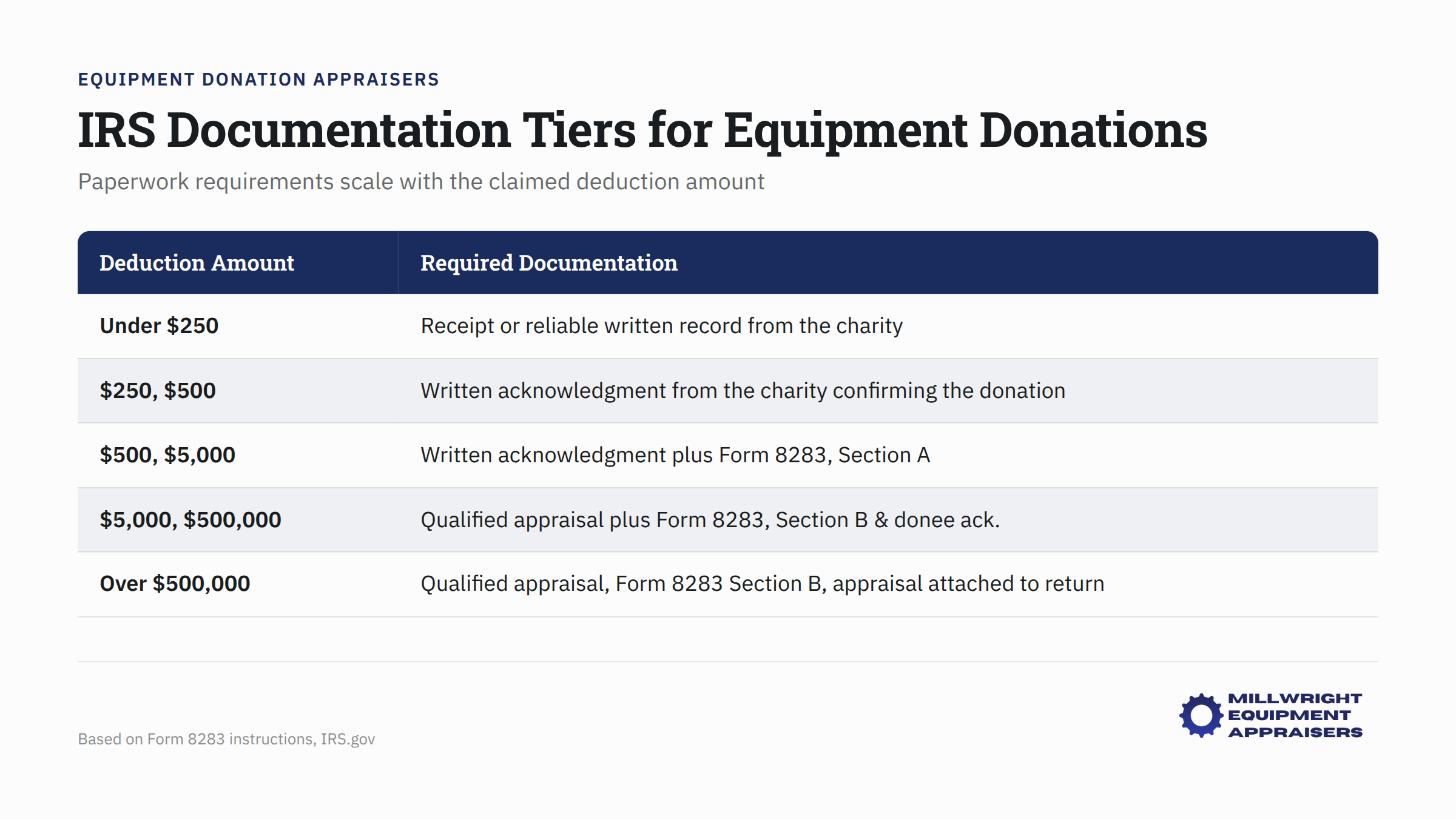
The table below summarizes what to keep at each threshold, since the requirements build on each other rather than replace one another.
| Claimed Deduction | Required Documentation | Who Provides It |
|---|---|---|
| Under $250 | Receipt or written record of the gift | Donor |
| $250 to $500 | Contemporaneous written acknowledgment (CWA) | Charity |
| $500 to $5,000 | CWA plus Form 8283, Section A | Donor |
| $5,000 to $500,000 | CWA, Form 8283 Sections A and B, and a qualified appraisal | Donor, qualified appraiser, charity |
| Over $500,000 | All of the above, plus the full signed appraisal attached to the return | Donor, qualified appraiser, charity |
Keep the Paperwork Ahead of the Filing Deadline
The single biggest mistake in equipment donation recordkeeping is not missing a form, it's missing the timing. A CWA received after you file, an appraisal dated after the donation, or a Form 8283 filed without the donee's signature can each unravel a deduction that was otherwise handled correctly.
Build your documentation as the donation happens, not when your tax preparer asks for it in March. If your equipment donation is approaching the $5,000 mark, our team can prepare a qualified appraisal that satisfies Section B before you file, so the paperwork is ready when your return is.
This article is provided for general informational purposes only and does not constitute legal, tax, or financial advice. Readers should consult a qualified attorney or CPA regarding their specific circumstances.