
Blog
How to Complete IRS Form 8283 for an Equipment Donation, Step by Step
Equipment donations over $500 require IRS Form 8283, and once the deduction passes $5,000 you also need a qualified appraisal and additional signatures. This step-by-step guide covers Section A versus Section B, the appraiser and donee sections, and the mistakes that most often trigger IRS scrutiny.
Donating a piece of equipment to charity, whether it's a single forklift or a warehouse full of retired machinery, can produce a meaningful tax deduction. But the IRS does not take your word for the value. Once your noncash deduction for equipment passes $500, you must file IRS Form 8283, and the form gets more demanding as the dollar amount climbs. This guide walks through exactly which section applies, how to fill out each part, and the mistakes that get equipment donations flagged.
If you're still deciding whether your donation even needs an appraisal, our guide on qualified appraisal thresholds for equipment donations covers that question in more detail. For the appraisal itself, our equipment donation appraisal service prepares the qualified appraisal and completes the appraiser sections of Form 8283 for you.
Step 1: Determine Whether You Need Section A or Section B
The section you complete depends entirely on the claimed deduction for the item, or for the group of similar items, not on your total charitable giving for the year. A single machine valued at $3,000 goes in Section A. A group of similar machines that together are valued at $18,000 goes in Section B, even if no individual machine is worth more than $5,000 on its own.
The Form 8283 instructions set out three thresholds that control the paperwork:
- More than $500 total for the year: You must attach at least one Form 8283 to your return.
- More than $500 but not more than $5,000 per item or group of similar items: Complete Section A only. No appraisal is required.
- More than $5,000 per item or group of similar items: Complete Section B, obtain a qualified appraisal, and get the appraiser's and donee's signatures.
A fourth threshold applies at the top end: if the claimed deduction for an item or group requiring an appraisal exceeds $500,000, Publication 561 requires you to attach the entire qualified appraisal to your return, not just the summary information on Form 8283.
What Counts as a "Group of Similar Items" for Equipment
This is where most equipment donors get tripped up. Publication 561 defines similar items as property of the same generic category or type. For equipment, that means machines that perform the same general function or belong to the same class, not simply items donated on the same day to the same charity.
Example: If you donate five identical CNC machines to a technical school in one tax year, the IRS treats them as a group of similar items and you aggregate their combined value to determine whether Section A or Section B applies. If you donate two CNC machines and a forklift, the forklift is a dissimilar item and should be evaluated separately, even though it went to the same donee on the same date.
Dissimilar equipment types can still appear in the same appraisal report, as long as each type is broken out in its own section with its own valuation conclusion. Similar items donated to different donees, however, each require their own Form 8283.
Section A vs Section B: What's Required
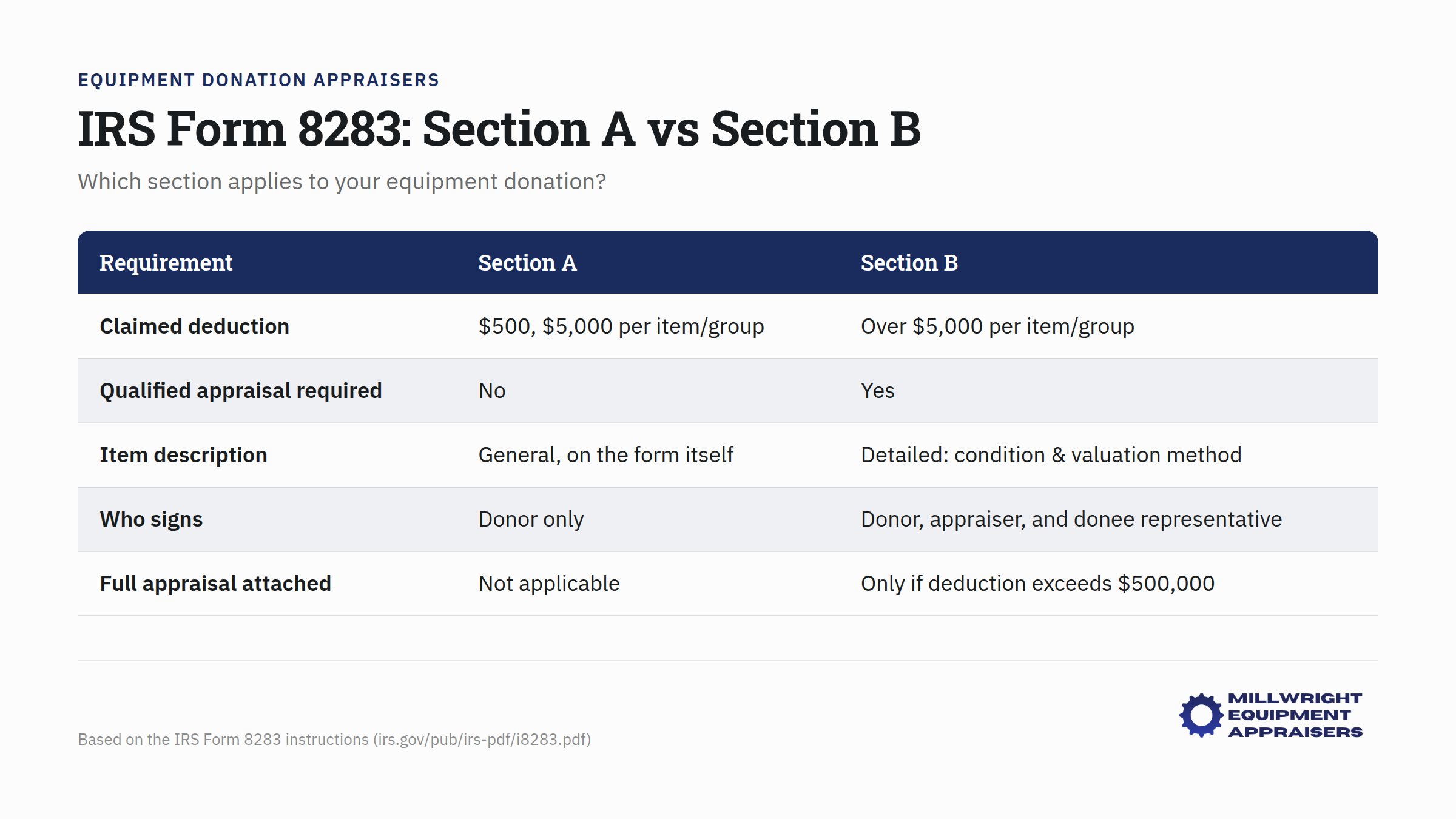
Before you start filling in fields, confirm which section applies using the table below. It reflects the requirements set out in the Form 8283 instructions.
| Section A | Section B | |
|---|---|---|
| Claimed deduction | More than $500, up to $5,000 per item or group of similar items | More than $5,000 per item or group of similar items |
| Qualified appraisal required | No | Yes |
| Item description | General description on the form itself | Detailed description, condition, and valuation method |
| Who signs | Donor only | Donor, qualified appraiser, and an authorized donee representative |
| Full appraisal attached to return | Not applicable | Only if the claimed deduction exceeds $500,000 |
Step 2: Complete Section B, Part I: Information on Donated Property
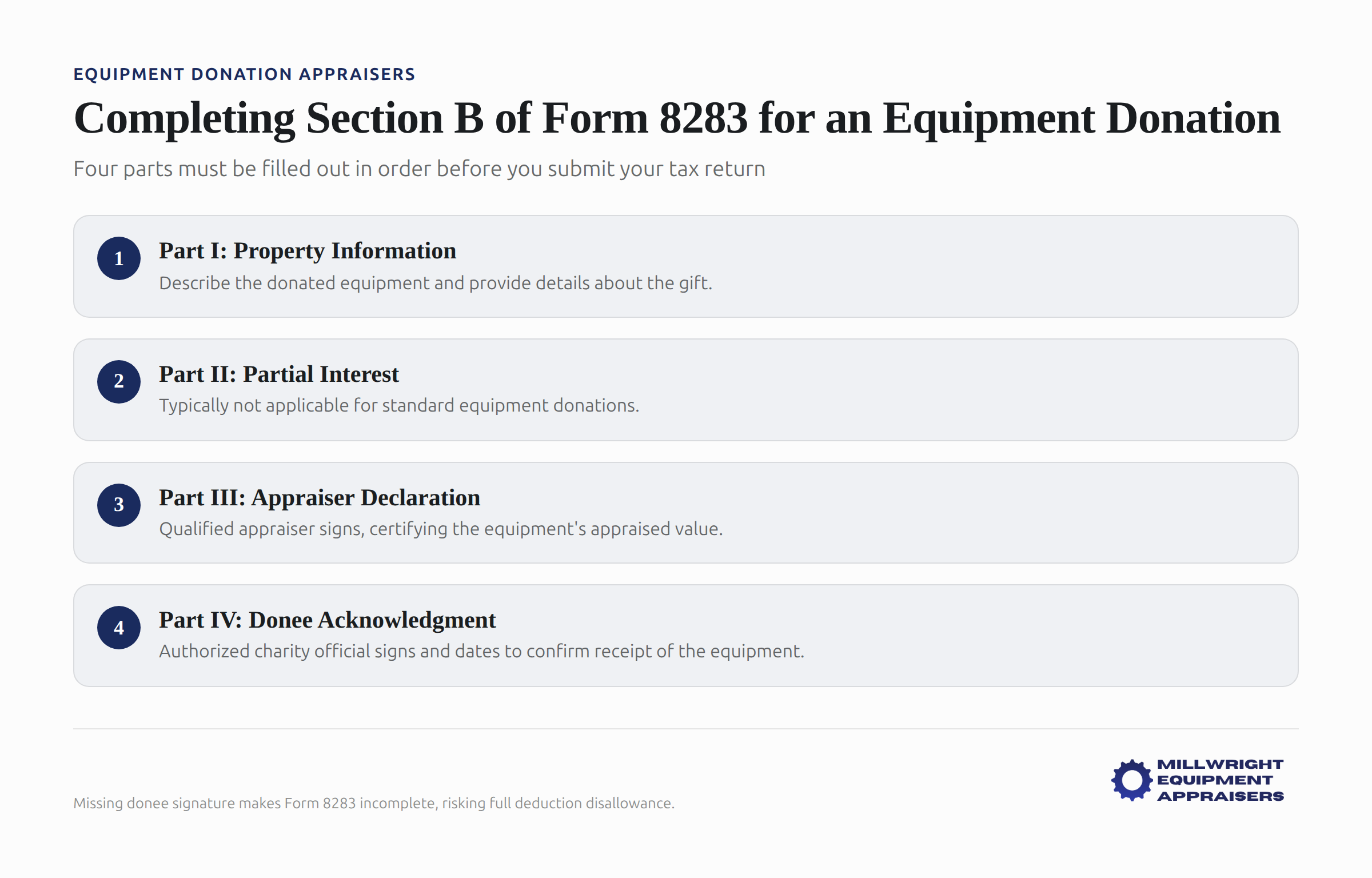
If your equipment donation lands in Section B, Part I is where you describe the property and the transaction. This is the section reviewers check first, so incomplete entries here are one of the fastest ways to draw follow-up questions.
For each item or group, you'll need:
- Donee organization's name and address, exactly as the charity is registered.
- Detailed description of the equipment, including make, model, serial number, age, and condition. "Used machinery" is not sufficient; "2016 Haas VF-2 vertical machining center, serial number XXXXX, functional condition" is.
- Date acquired by the donor and how it was acquired (purchased, inherited, built in-house).
- Donor's cost or adjusted basis in the equipment.
- Date of contribution to the donee.
- Fair market value on the date of contribution, along with the method used to determine that value, such as a qualified appraisal, comparable sales, or a used-equipment pricing guide.
If the equipment was used in your trade or business, note whether it qualifies as related-use or unrelated-use property for the donee. That distinction can limit your deduction to basis rather than fair market value under the ordinary income property rules, so it's worth confirming with a tax professional before you file.
Step 3: Part II, Partial Interests and Restricted Use Property
Part II asks whether you're donating less than your entire interest in the property, or whether the donation is subject to any restriction on the donee's use or ability to sell it. For the overwhelming majority of equipment donations, where a business or individual donates full, unrestricted ownership of a machine outright, this part is not applicable and can be left blank or marked N/A.
Part II becomes relevant mainly for fractional gifts (donating partial ownership of an asset over multiple years) or donations that come with a use restriction attached. If neither applies to your equipment donation, move on to Part III.
Step 4: Part III, Declaration of Appraiser
This is the section that gets equipment donors in trouble more than any other, because it has to be completed by someone who isn't the donor.
The qualified appraiser signs Part III, attesting to their qualifications and the appraisal itself under penalty of perjury. Publication 561 spells out who is disqualified from serving as the appraiser for your donation, and the list matters:
- The donor, or the party who prepared the return claiming the deduction.
- A party to the transaction in which the donor acquired the equipment, unless the donation is made within two months of acquisition and the appraised value doesn't exceed the acquisition price.
- An employee, agent, or someone regularly used by the donor or the donee, unless that person is independently qualified and performs a majority of their appraisals for unrelated parties.
- Anyone whose fee for the appraisal is based on a percentage of the appraised value.
The appraisal also has to be timely. Per the appraisal requirements referenced in the Form 8283 instructions, the appraisal cannot be made earlier than 60 days before the date of the donation, and it must be received by the donor before the due date of the tax return on which the deduction is first claimed, including extensions. An appraisal dated too far in advance, or one obtained after the return is filed, does not satisfy the qualified appraisal requirement.
Watch out: A 2024 revision to Form 8283 added a requirement for taxpayers claiming a share of a pass-through entity's noncash contribution to disclose the name and identifying number of the entity that made the original donation, as RSM's tax alert explains. If your equipment donation flowed through a partnership or S corporation, confirm this line is completed correctly.
Step 5: Part IV, Donee Acknowledgment
The final signature belongs to the donee organization. An authorized official of the charity, someone with the authority to sign the organization's tax returns or a person specifically designated for this purpose, signs Part IV to acknowledge receipt of the equipment described in Part I.
By signing, the donee is also acknowledging its understanding of the reporting obligations that follow. If the organization disposes of the donated equipment within three years of receiving it, it generally must file Form 8282 with the IRS and send you a copy, unless the item was valued at $500 or less.
Make sure the donee signs and dates Part IV before you submit your return. A Form 8283 missing this signature is treated as incomplete, and an incomplete Section B can result in the entire deduction being disallowed.
Common Mistakes That Trigger IRS Scrutiny
Most problems with equipment donations trace back to a handful of recurring errors:
- Misclassifying Section A vs Section B. Filing in Section A when the aggregated value of similar equipment actually exceeds $5,000 is one of the most common triggers for an IRS inquiry.
- Missing the appraiser's signature. Part III has to be signed by the appraiser, not just referenced. A summary without a signature does not meet the qualified appraisal standard.
- Vague item descriptions. "Assorted shop equipment" invites questions. Serial numbers, model numbers, and condition notes protect the deduction.
- Improperly aggregating dissimilar equipment. Grouping a generator, a conveyor, and a forklift together as one "group of similar items" misapplies the aggregation rule and can undermine the entire valuation.
- Appraisal timing outside the window. An appraisal dated more than 60 days before the donation, or delivered after the tax return's due date (including extensions), fails the qualified appraisal test outright.
- A disqualified appraiser. Using the equipment dealer who sold you the machine, an employee, or anyone paid a percentage of the appraised value voids the appraisal for tax purposes.
Getting the Paperwork Right the First Time
Form 8283 rewards precision. Confirm your section, aggregate similar equipment correctly, use an independent qualified appraiser who signs and dates within the required window, and get the donee's signature before you file. Doing this correctly the first time is far easier than trying to reconstruct documentation after the IRS asks questions.
If you're preparing to donate equipment and need a qualified appraisal that meets these requirements, our equipment donation appraisal service handles the valuation and completes the appraiser sections of Form 8283 as part of the engagement. You can also browse our full library of guides on equipment donation appraisals for related documentation and valuation topics.
This article is provided for general informational purposes only and does not constitute legal, tax, or financial advice. Readers should consult a qualified attorney or CPA regarding their specific circumstances.