
Blog
Donating Medical Equipment to Charity: Appraisal and Tax Rules You Need to Know
A medical equipment donation appraisal has to account for obsolescence, FDA status, and service records that generic equipment appraisals never touch. This guide walks retiring physicians and clinic administrators through the $5,000 qualified appraisal threshold, the aggregation rule, and the documentation an IRS-ready report must include.
Hospital beds, infusion pumps, patient monitors, and imaging systems do not behave like filing cabinets or forklifts when it comes time to document a charitable donation. A retiring physician closing a practice, or a hospital administrator decommissioning a unit, faces the same IRS appraisal framework as any other equipment donor, but the underlying asset is harder to value and carries more compliance weight. Our team prepares equipment donation appraisals for exactly this situation, and the rules below cover the dollar thresholds, the aggregation trap, and the documentation a defensible medical equipment appraisal needs to survive IRS review.
Why Medical Equipment Is Harder to Value Than Office or Industrial Equipment
Medical devices lose value on a different curve than general equipment, and the reasons go well beyond ordinary wear. A generic office chair or a metalworking lathe degrades predictably with age and use. A patient monitor or an imaging system can become functionally obsolete the day a manufacturer releases a new software platform or a hospital system standardizes on a different vendor, regardless of how well the unit has been maintained.
Four factors drive this gap:
- Technological obsolescence: Diagnostic and imaging equipment is tied to software and interoperability standards that shift fast. A five-year-old ultrasound unit may be mechanically sound but commercially undesirable because it cannot run current imaging protocols.
- FDA labeling and recall status: Whether a device carries an active FDA clearance, has been subject to a recall, or has had its labeling withdrawn materially changes what a buyer in the secondary market will pay, and an appraiser has to check this before assigning value.
- Calibration and service history: Infusion pumps, ventilators, and monitors require documented calibration and maintenance records to be usable at all. Equipment without a service history is often worth a fraction of an identical unit with complete records, because the receiving organization inherits the cost of recertification.
- Functional versus for-parts status: A ventilator that powers on but fails a leak test is not valued the same way as one cleared for clinical use. Appraisers have to state explicitly which category a device falls into, since treating a for-parts unit as functional inflates the claimed deduction.
Generic equipment appraisal checklists built for forklifts or office furniture simply do not capture these variables, which is why medical equipment donations deserve a specialist's eye rather than a generic cost-to-value formula.
The $5,000 Qualified Appraisal Threshold and Form 8283 Section B
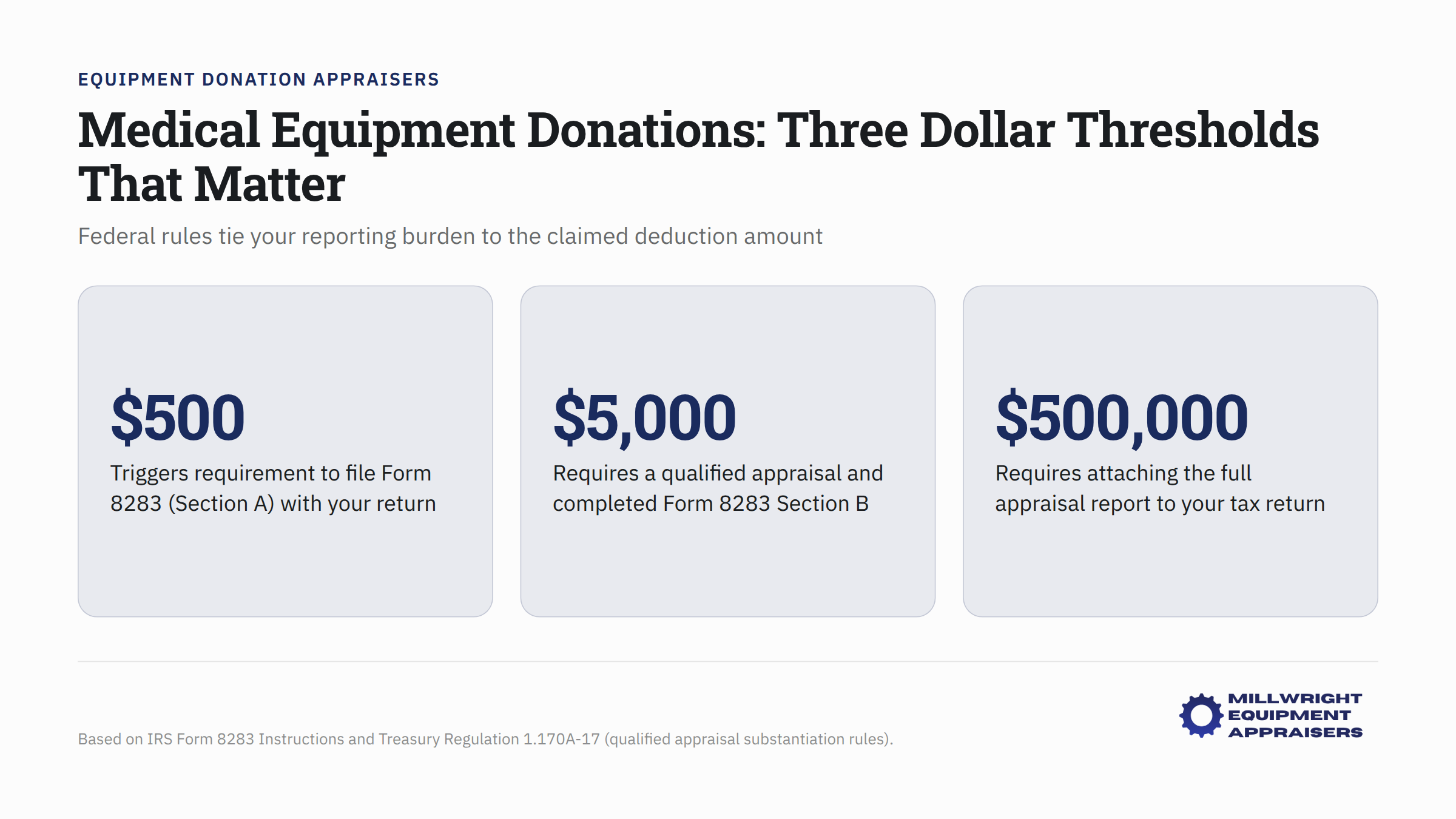
If the claimed deduction for a piece of medical equipment, or a group of similar medical devices, exceeds $5,000, federal law generally requires a qualified appraisal and a completed Section B of IRS Form 8283. Below that threshold, a donor claiming more than $500 in total noncash contributions still files Form 8283, but only Section A, with less detailed reporting.
The $5,000 rule traces back to the charitable contribution provisions of the Internal Revenue Code, and the specific content a qualified appraisal must contain is set out in Treasury regulations governing substantiation of noncash gifts. According to the IRS Form 8283 Instructions, Form 8283 itself is an appraisal summary, not the appraisal: the donor must still obtain and retain a separate written appraisal report, and the donee organization must sign Section B acknowledging receipt of the described property.
Treasury's qualified appraisal rules require the report to follow the substance and principles of the Uniform Standards of Professional Appraisal Practice (USPAP), published by The Appraisal Foundation, and to be prepared by a qualified appraiser whose background matches the asset. Treasury Regulation 1.170A-17 specifically requires the appraisal of tangible personal property to address the item's condition, a detail that matters enormously for a used infusion pump or hospital bed where condition drives most of the remaining value.
Donors weighing whether they have crossed the $5,000 line, and what Form 8283 section applies, can walk through the full breakdown in our guide on whether a qualified appraisal is required for your equipment donation.
The 60-Day Appraisal Window Donors Often Miss
The appraisal's valuation effective date has to fall within a narrow window around the donation. IRS Publication 526 states that a qualified appraisal must be made no earlier than 60 days before the contribution date, and the report itself must generally be received by the time the return reporting the deduction is due.
This timing rule trips up practices in the middle of closing down operations. A clinic that schedules an appraisal six months before it finally transfers equipment to a receiving charity has a stale valuation date and will likely need the appraiser to update the effective date closer to the actual transfer. The safest sequence is to finalize the donation agreement with the receiving organization first, then schedule the appraisal within the 60-day window that precedes the actual transfer.
Watch out: If the appraisal report itself is signed and dated after the donation has already occurred, the valuation effective date inside the report still has to match the contribution date, not the date the appraiser wrote the report.
How the Similar Items Aggregation Rule Applies to Medical Devices
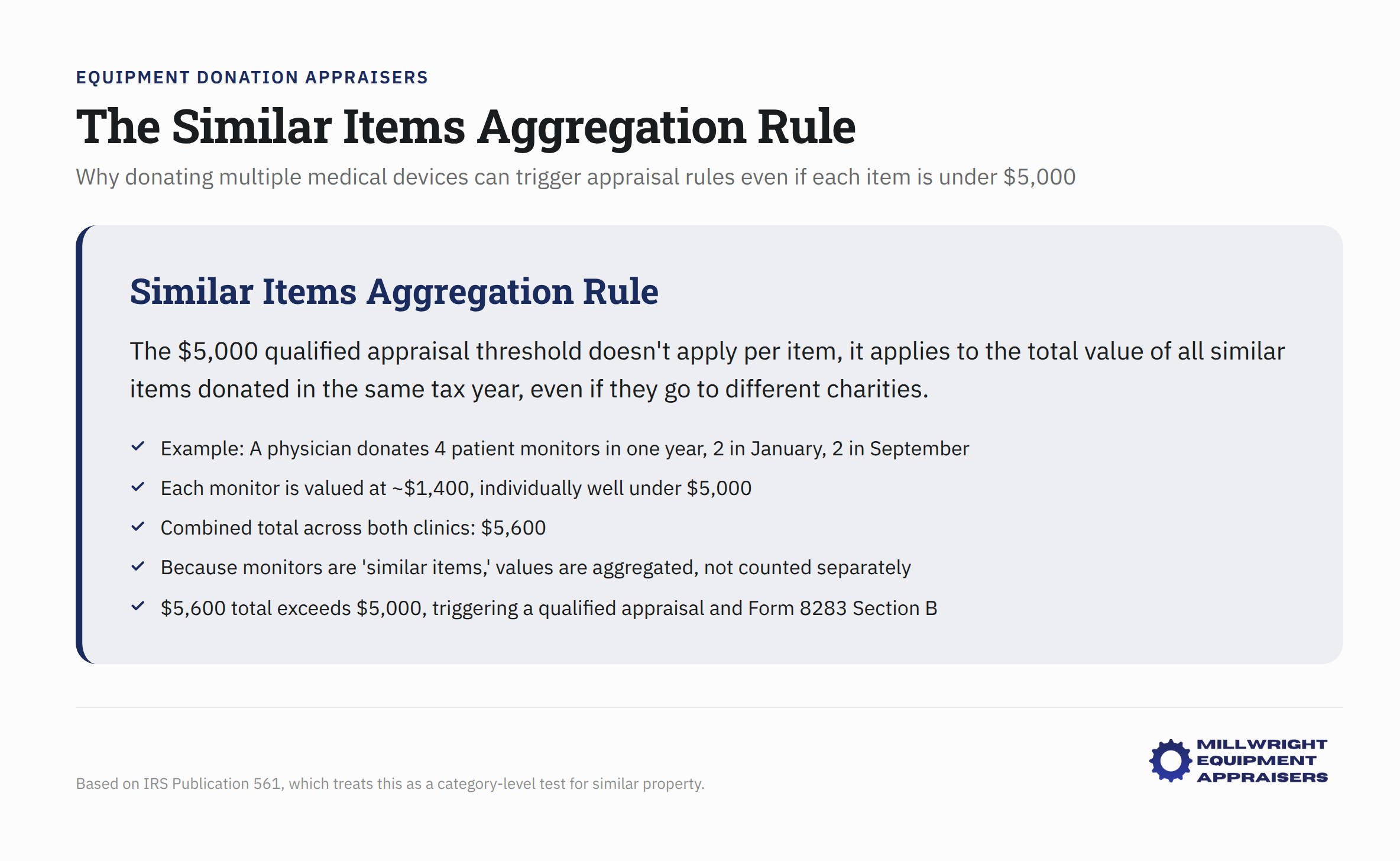
The $5,000 threshold does not apply item by item. It applies to the aggregate value of similar items donated during the same tax year, even when no single item crosses $5,000 on its own and even when the items go to different charities.
For a hospital or clinic donating multiple devices, this rule changes the math quickly. A donor who gives three hospital beds valued at $1,800 each, in the same tax year, to three separate shelters has donated $5,400 in a single category of similar property. That crosses the qualified appraisal threshold even though every individual bed falls well under $5,000. The same logic applies to a batch of patient monitors, infusion pumps, or surgical instruments donated across multiple recipients.
Example: A retiring physician donates four patient monitors over the course of a year, two to a free clinic in January and two to a different clinic in September, each valued around $1,400. Individually, none requires an appraisal. Aggregated as a category of similar items, the $5,600 total pushes the donor over the $5,000 line and triggers the qualified appraisal and Form 8283 Section B requirement.
Publication 561 frames this as a category-level test, which means donors planning multiple equipment donations in the same calendar year should tally similar devices across every recipient before assuming any individual gift falls below the reporting line. Our breakdown of how the aggregation rule applies to multiple equipment donations covers how to group assets correctly.
Confirming the Charity Can Legally Receive and Use the Equipment
Not every nonprofit is positioned to accept every category of medical device, and this is a step donors frequently skip. Equipment that produces ionizing radiation, such as X-ray or CT imaging systems, often carries state-level licensing, registration, or inspection requirements that apply to both the donor and the recipient facility. A receiving charity without the proper state authorization may be unable to install or operate the equipment at all, regardless of its appraised value.
Beyond radiation-producing equipment, donors should confirm the charity is organized to use the device for a purpose related to its exempt mission. The substantiation rules for noncash gifts ask whether the donee has certified a related use, and IRS guidance on substantiating noncash contributions notes that the donee organization is not itself treated as a qualified appraiser of the property it receives. If a charity cannot use donated equipment for a mission-related purpose and instead sells it shortly after the gift, the deduction available to the donor can be limited under the Internal Revenue Code's rules for tangible personal property donations.
Pro tip: Get the charity's intended use in writing before the appraisal is finalized. The appraiser needs to know whether a ventilator is headed for clinical use in a field hospital or for resale, because that distinction can change both the valuation approach and the deduction limits that apply.
What a Defensible Medical Equipment Appraisal Documents
A medical equipment appraisal built to survive IRS scrutiny needs to go well past a serial number and a price. At minimum, the report should document the following:
- Asset identification: manufacturer, model, serial number, year of manufacture, and photographs of the unit.
- Regulatory status: current FDA clearance, labeling, or any recall history affecting the specific model.
- Condition and functionality: whether the device is fully operational, operational with limitations, or for-parts only.
- Service and calibration records: maintenance history, last calibration date, and any outstanding service needs.
- Comparable transactions: sales of similar equipment in similar condition, used to support the fair market value conclusion.
- Valuation methodology: the specific approach applied (sales comparison, cost, or income) and why it fits this asset.
- Intended use by the donee: whether the receiving charity will use the equipment for patient care or for another related purpose.
This level of detail is what separates a usable charitable contribution appraisal from a generic equipment valuation. An appraiser working from a template built for office furniture will miss the FDA status, calibration, and functional-versus-for-parts distinctions that actually drive a medical device's fair market value.
What This Means for Retiring Physicians and Closing Practices
Practices winding down operations typically have more at stake than a single item. A retiring physician donating an exam room's worth of equipment, or a hospital administrator clearing out a decommissioned wing, is usually dealing with dozens of assets across several categories: monitors, beds, pumps, diagnostic tools, and furniture. Each category gets evaluated on its own for the aggregation rule, and categories with higher per-unit values (imaging systems, surgical equipment) are far more likely to individually cross the $5,000 line.
Appraisal fees for this work are quoted as a fixed fee after the assignment is scoped, never billed hourly, and the fee is driven by the complexity of the equipment, the number of assets involved, the completeness of existing service and calibration records, and whether the appraisal needs to meet the IRS-qualified standard. For medical equipment specifically, standard appraisal reports typically start at $295, with IRS-qualified reports starting at $395; most engagements run $695 to $2,200, and large multi-device practice closures with complex documentation needs can run $5,000 to $10,000 or more.
Credentialing matters here too. Our appraisers hold credentials with organizations such as the ASA and ISA, and every report is prepared in accordance with USPAP so it holds up whether it supports an IRS filing, a donee's internal records, or a later audit inquiry.
Donating medical equipment at the end of a practice or a facility closure does not have to turn into a compliance headache. Getting the threshold, the timing, and the aggregation math right before the equipment leaves the building is what keeps the deduction defensible later.
This article is provided for general informational purposes only and does not constitute legal, tax, or financial advice. Readers should consult a qualified attorney or CPA regarding their specific circumstances.