
Blog
Fair Market Value vs Replacement Cost for Donated Equipment Explained
Fair market value, not replacement cost or a dealer's asking price, is the standard the IRS requires for valuing donated equipment. This guide breaks down why the two figures diverge and how comparable sales data gets you to a defensible number.
When a business donates a tractor, a generator, or a CNC machine to a school, church, or nonprofit, the first question is almost always: what is it worth? The instinct is to look at the replacement cost (what a new equivalent unit would cost) or the retail asking price on a dealer's website. Neither one is the number the IRS wants. This guide walks through the fair market value standard that governs equipment donations, why replacement cost and resale pricing routinely overstate that number, and how the dollar thresholds on Form 8283 determine how much documentation you need.
What Fair Market Value Means Under IRS Publication 561
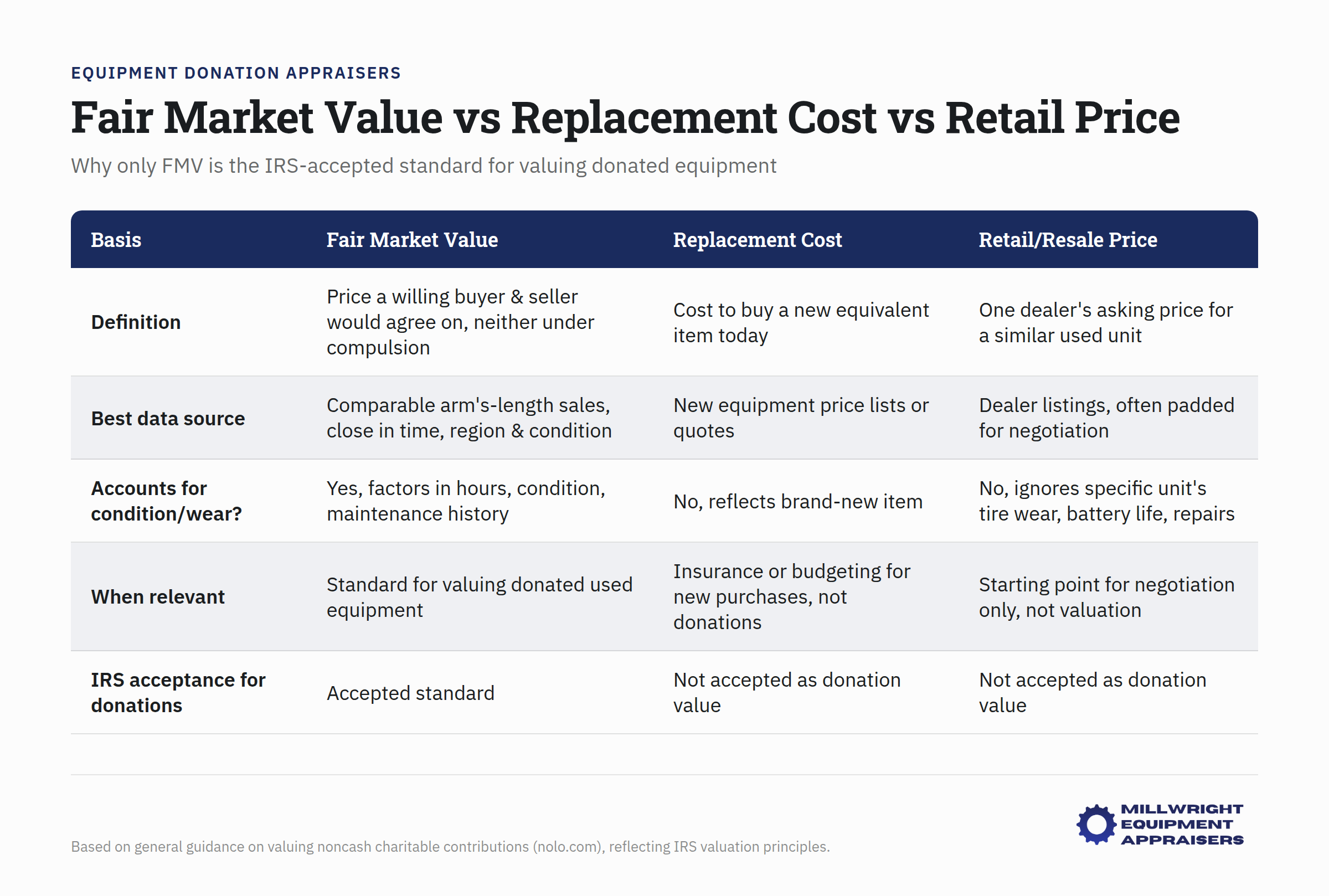
Fair market value is the price a piece of equipment would sell for on the open market between a willing buyer and a willing seller, with neither party under any pressure to act and both having reasonable knowledge of the relevant facts. That definition comes directly from IRS Publication 561, the government's primary guidance on valuing donated property, and it applies to a used forklift or medical imaging system exactly the same way it applies to art or jewelry.
The key phrase is "open market." FMV is not what the equipment cost when it was purchased, not what a dealer is asking for a similar unit, and not what it would cost to build or buy new. It is the price a real transaction would likely produce for that specific asset, in its actual condition, on the date of the gift. Our guide to determining fair market value for used equipment walks through the practical steps donors and appraisers take to reach that number.
Why Replacement Cost Is Not the Same as Fair Market Value
Replacement cost is a legitimate factor an appraiser may consider, but it is not fair market value, and the IRS is explicit that the two figures usually diverge. Publication 561 treats replacement cost as one input among several, not as a shortcut to a conclusion.
The reasoning is straightforward once you see it applied to real equipment:
- A generator that cost $18,000 new eight years ago might have a replacement cost today of $22,000 given inflation and updated emissions standards, but a buyer shopping the used market for that same wattage and age would pay far less.
- A CNC machine with obsolete tooling and no service contract may have a high replacement cost for a comparable new machine, but its FMV reflects the fact that few buyers want an unsupported legacy unit.
- A medical imaging system replaced by newer FDA-cleared technology can have a replacement cost in the hundreds of thousands, while its resale market shrinks to a narrow band of clinics or brokers willing to take on an older model.
When an appraiser does use replacement cost as a starting point, the analysis does not stop there. The estimated cost to replace the item new must be reduced by depreciation for physical wear, functional obsolescence, and economic obsolescence to arrive at a depreciated replacement cost, and that figure still has to show a reasonable relationship to what the market would actually pay. If it doesn't, the replacement cost approach gets set aside in favor of stronger evidence.
Watch out: Donors sometimes hand an appraiser a manufacturer's price sheet for a new equivalent model and call that the donation value. That number describes what it costs to buy new equipment, not what a nine-year-old tractor with 4,000 hours on it would fetch from a willing buyer.
The Problem With Using Retail or Resale List Prices
A used equipment dealer's listed asking price is not fair market value either, and this is one of the more common valuation mistakes we see. A resale listing reflects one seller's opening negotiating position, often padded to leave room for haggling, and it says nothing about the condition, hours, or maintenance history of the specific unit being donated. Two forklifts of the same model and year can list at the same retail price while being worth very different amounts once you account for tire wear, battery life, or accumulated repair history.
Comparable sales of similar used equipment are a much stronger factor than a list price. General guidance on valuing noncash charitable contributions points to the same principle the IRS applies across all donated property: the closer a comparable transaction is to the donated item in similarity, timing, geographic market, and arm's-length circumstances, the more weight it carries. An actual sale of a comparable forklift, closed within the same region and around the same date as the donation, tells you far more than a dealer's sticker price.
Fair Market Value vs Replacement Cost vs Retail Price
Comparable Sales: The Strongest Evidence for Equipment FMV
Because equipment markets are active and reasonably transparent, actual sales of similar used units are usually the best evidence of FMV available to an appraiser. For this evidence to carry weight, the comparable sale needs to meet a few conditions: it should involve a similar make, model, age, and condition; it should have closed close to the donation date; it should reflect an arm's-length transaction where neither party was compelled to buy or sell; and it should come from the same general market area as the donated item.
Example: A landscaping company donates a five-year-old tractor with moderate wear to a vocational school. Rather than pricing it off a manufacturer's new-model catalog, the appraiser researches recent sales of comparable tractors of the same make, horsepower, and hour count sold through regional equipment auctions and dealer trade-ins. Those transactions, adjusted for any differences in condition, produce a defensible FMV that a manufacturer's price sheet never could.
Form 8283 and the Dollar Thresholds That Trigger Extra Documentation
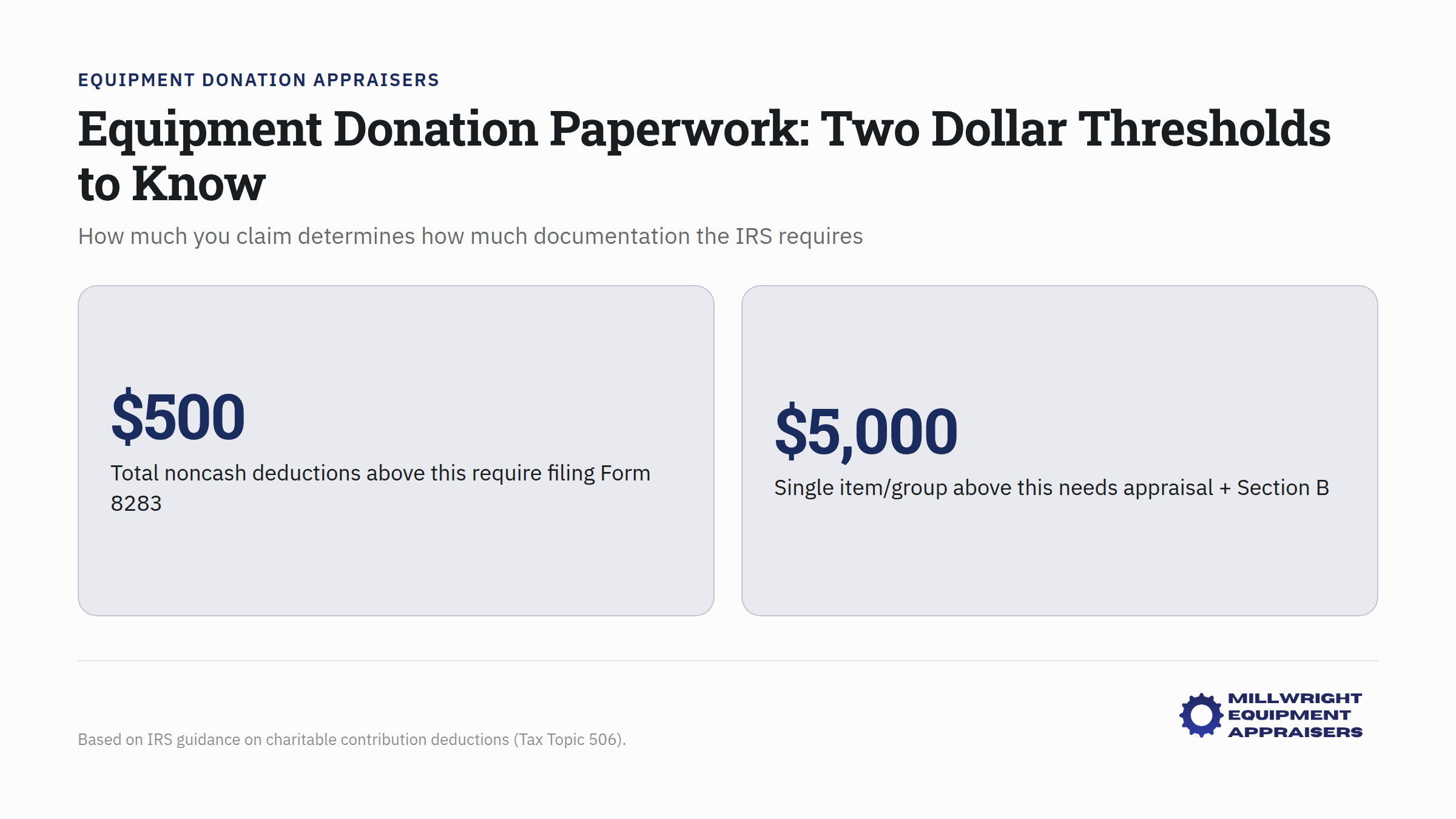
Once you have a defensible FMV, the next question is how much paperwork the donation requires, and that turns entirely on dollar thresholds rather than the type of equipment donated. Any donor claiming more than $500 in total noncash charitable deductions for the tax year must file Form 8283 with their return, according to IRS guidance on charitable contribution deductions.
The stakes rise sharply at the next threshold. When a single item, or a group of similar items donated together, carries a claimed deduction over $5,000, the donor generally needs a qualified appraisal and must complete Section B of Form 8283. Our breakdown of the $5,000 qualified appraisal threshold covers exactly which donations cross that line and what a qualified appraisal has to include.
How Nonprofits Record Donated Equipment They Receive
The fair market value standard is not just a donor-side concern. Nonprofits that accept donated equipment generally record the gift on their books at fair value, following accounting guidance for in-kind donations that mirrors the same market-based logic the IRS applies to the donor's deduction. A recipient organization researching what a donated CNC machine or hospital bed is worth for its own financial statements is answering the same underlying question a donor's appraiser is answering: what would this asset actually sell for, not what would it cost to replace.
That overlap is useful. When a nonprofit and a donor rely on consistent, well-documented FMV figures, both sides avoid the mismatch that triggers IRS scrutiny or an awkward restatement of financial records later.
Getting a Defensible Number for Your Equipment Donation
Fair market value, comparable sales evidence, and a properly documented appraisal are what stand between a smooth tax filing and a denied deduction. Replacement cost and retail pricing are tempting shortcuts because they are easy to find online, but they rarely reflect what a specific, used piece of equipment would actually bring in an arm's-length sale. Our appraisers prepare USPAP-compliant valuations for donated tractors, generators, forklifts, CNC machines, and medical equipment, built on the comparable sales and market data that IRS Publication 561 actually requires.
If you're preparing to donate business equipment and need a number that will hold up on Form 8283, our team can scope and prepare a qualified appraisal before you file. For more background on the rules and documentation behind equipment donation valuations, read our equipment donation appraisal blog.
This article is provided for general informational purposes only and does not constitute legal, tax, or financial advice. Readers should consult a qualified attorney or CPA regarding their specific circumstances.