
Blog
Form 8283 Section A vs Section B: Which One Applies to Your Equipment Donation?
Whether your donated tractor, forklift, or shop equipment belongs in Form 8283 Section A or Section B comes down to one number: the claimed deduction for that item or group of similar equipment. This guide shows how to total that figure and which paperwork each section demands.
If you are donating a tractor, a forklift, or a warehouse full of used machinery to a nonprofit, the IRS wants Form 8283 attached to your return once your total noncash contribution deduction passes $500. Which section you complete, Section A or Section B, depends entirely on the dollar amount claimed for that item or group of similar equipment. Get the section wrong, or skip the paperwork it requires, and the deduction can be denied outright. This guide walks through the decision path: how to total your claimed value, which section applies, and what each one requires before you file.
The $500 Threshold: When Form 8283 Applies at All
Form 8283 is required any time your total deduction for noncash charitable contributions in a tax year exceeds $500, according to the IRS Form 8283 instructions. Below that, equipment donations typically only need a receipt from the donee organization and your own records of value. Above it, the form becomes mandatory, and the amount you claim for a specific item (or group of similar items) determines which section of the form you fill out.
For equipment donors, this is rarely about a single machine in isolation. A donated tractor plus its attached implements, or a set of donated shop tools, often get grouped as similar items for this purpose, which changes how you calculate the threshold.
Totaling Your Equipment's Claimed Deduction: The Decision Path
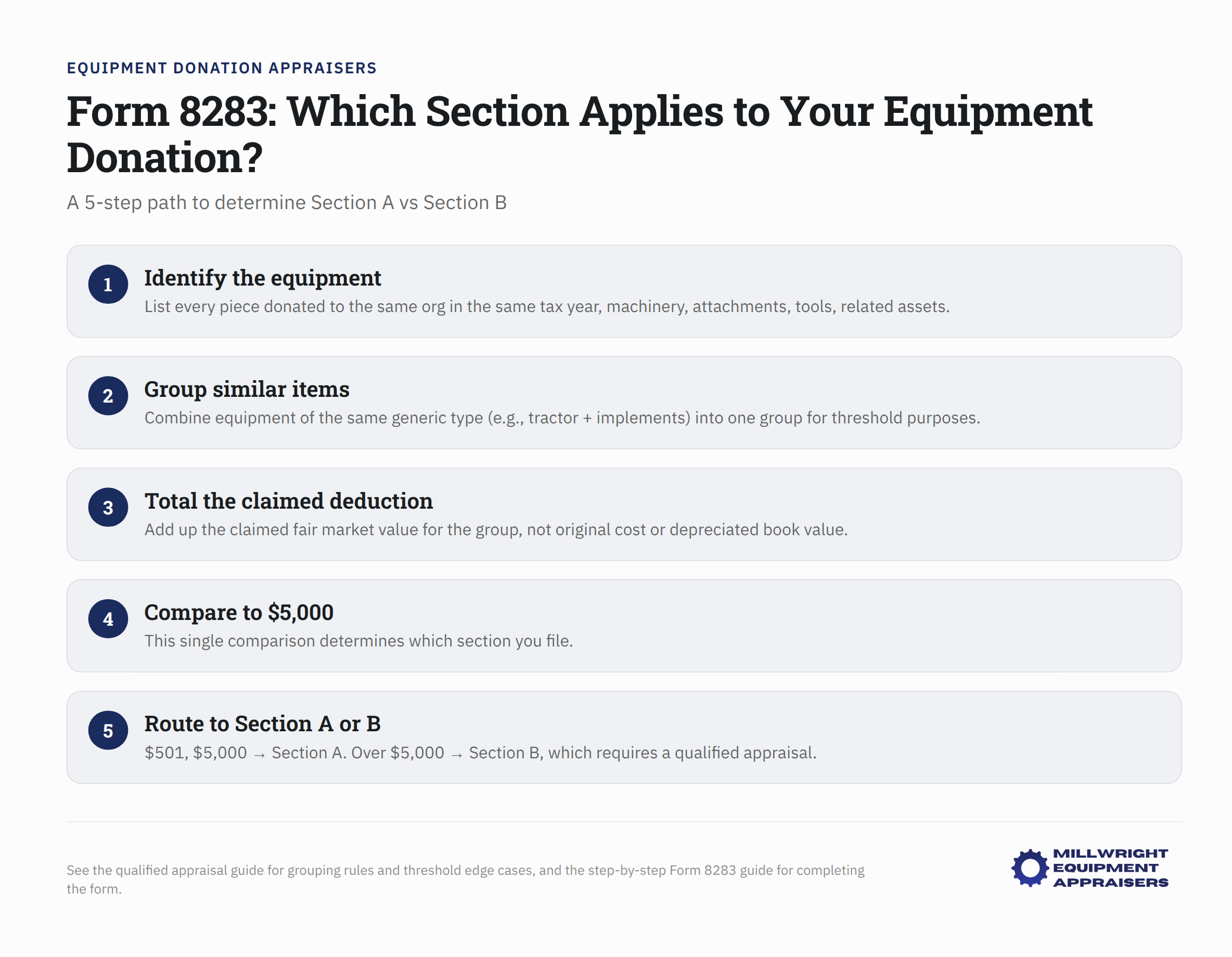
Before you can pick a section, you need one number: the claimed deduction for the item or group of similar equipment you donated. Work through it in order.
- Identify every piece of equipment donated to the same organization in the same tax year. This includes machinery, attachments, tools, and related assets given together or separately.
- Group similar items together. Equipment of the same generic type, such as a tractor and its implements, or a set of machine tools, generally counts as one group for threshold purposes.
- Total the claimed fair market value for that group, not the original purchase price or depreciated book value. The deduction amount is what matters, not what you originally paid.
- Compare the total to $5,000. This single comparison decides your section.
- Route the paperwork accordingly. $501 to $5,000 goes in Section A. More than $5,000 goes in Section B, which brings a qualified appraisal into play.
Our qualified appraisal guide for equipment donations walks through grouping rules and threshold edge cases in more depth if your donation sits close to the line. If you want a full walkthrough of completing the form itself, see our step-by-step Form 8283 guide.
Section A: Equipment Donations of $501 to $5,000
Section A applies when the claimed deduction for an item or group of similar equipment is more than $500 but not more than $5,000. No appraiser signature is required here. You still need to describe the equipment, state how you determined the value (comparable sales, a dealer quote, cost minus depreciation), and provide the donee organization's information.
This is the section most small equipment donations fall into: a single used generator, a handful of hand tools, a donated compressor given to a trade school. The documentation burden is lighter, but it is not optional. The IRS Form 8283 instructions still require a reasonable, supportable basis for the value claimed, even without a formal appraisal attached.
Section B: Equipment Donations Over $5,000
Section B applies once the claimed deduction for an item or group of similar equipment exceeds $5,000. This is where the paperwork gets heavier, and where most equipment donors run into trouble if they have not planned ahead.
Section B requires all of the following:
- A qualified appraisal, prepared by a qualified appraiser, supporting the claimed fair market value.
- The Declaration of Appraiser in Part IV, signed by the appraiser who prepared the report.
- The donee organization's signature in Part V, acknowledging receipt of the property.
- An appraisal date that falls in the correct window: no earlier than 60 days before the contribution date, and no later than the due date (including extensions) of the return claiming the deduction, per the qualified appraisal regulations under 26 C.F.R. §1.170A-17.
A separate qualified appraisal and a separate Form 8283 are generally required for each item, except when the item is part of a group of similar items. Only one appraisal is needed for a group of similar equipment donated to the same organization in the same tax year, as long as that appraisal covers all the required information for each piece. For guidance on who is actually eligible to sign Part IV, see our rundown of qualified appraiser requirements for equipment donations.
Section A vs Section B at a Glance
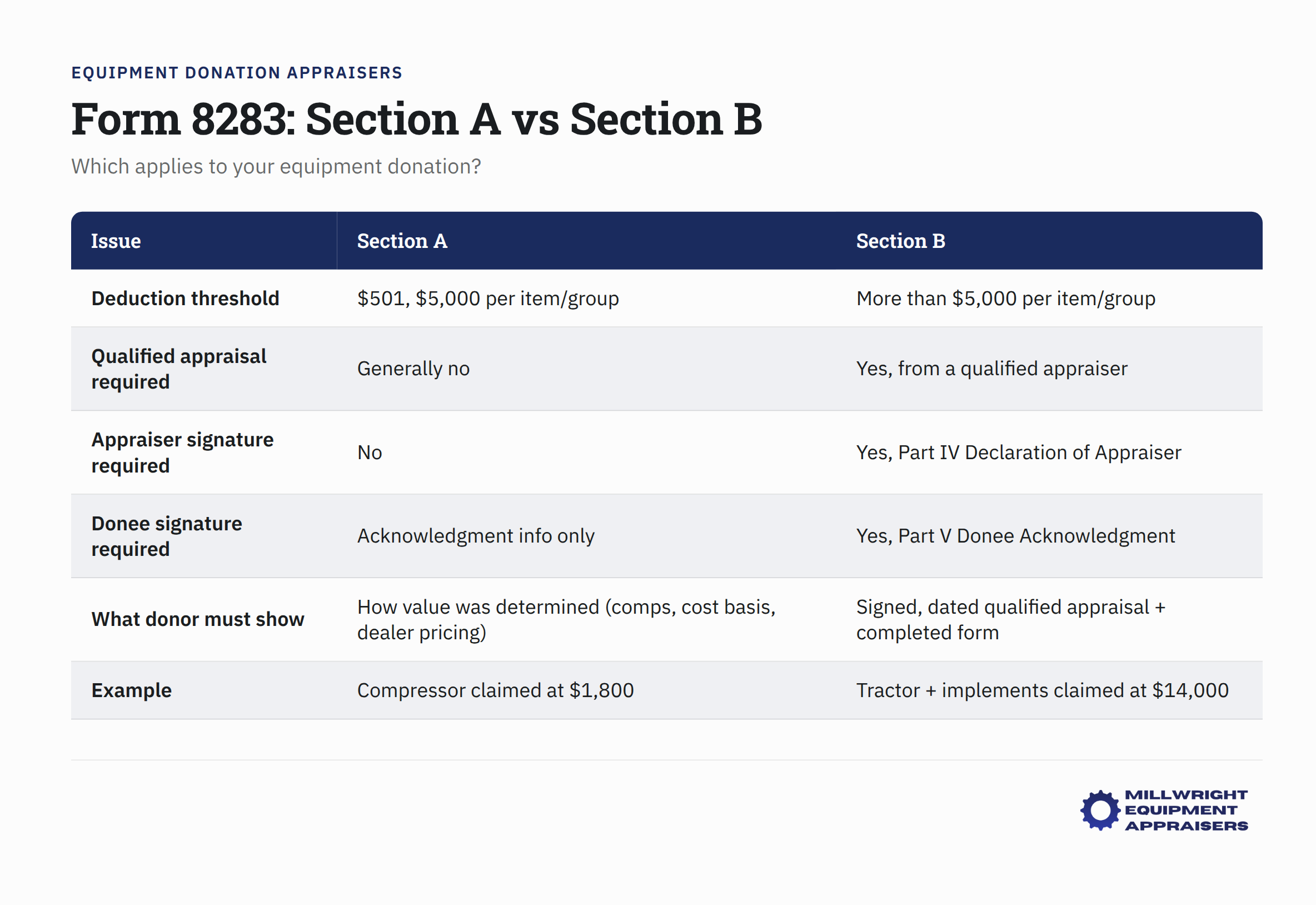
The table below summarizes the practical differences once you know your claimed deduction amount.
| Issue | Section A | Section B |
|---|---|---|
| Deduction threshold | $501 to $5,000 per item or group of similar items | More than $5,000 per item or group of similar items |
| Qualified appraisal required | Generally no | Yes, from a qualified appraiser |
| Appraiser signature required | No | Yes, Part IV Declaration of Appraiser |
| Donee signature required | Donee acknowledgment information only | Yes, Part V Donee Acknowledgment |
| What the donor must show | How the value was determined (comparable sales, cost basis, dealer pricing) | A signed, dated qualified appraisal report plus the completed form |
| Example | A donated compressor claimed at $1,800 | A donated tractor and implements claimed together at $14,000 |
What Counts as a Group of Similar Equipment?
Similar items of property are items of the same generic category or type. For equipment donors, this typically means machines that serve a related function or belong to the same class, such as a tractor donated with its attached implements, or a set of machine shop tools given together. The IRS guidance on valuing donated property uses this grouping concept to determine when one appraisal can cover multiple items rather than requiring a separate report for each.
Grouping matters because it is cumulative. A donor who gives three pieces of similar equipment to the same charity in the same year, each claimed at $2,000, has a $6,000 group claim even though no single item crosses $5,000 on its own. That pushes the entire group into Section B, with the qualified appraisal requirement attached.
Pro tip: If your equipment donations to one organization are creeping toward $5,000 across the year, it is worth getting an appraisal scoped before you file rather than after, since a qualified appraisal generally cannot be prepared more than 60 days before the contribution and must be finished by the time your return is due.
Who Can Sign as a Qualified Appraiser for Equipment
A qualified appraiser cannot be the donor, the donee, a party to the transaction in which the donor acquired the property (with a narrow exception), or an employee of any of those parties. The appraiser also needs to hold the kind of credentials and experience that let them speak to the equipment's market value with authority.
For machinery and equipment specifically, that typically means credentials from organizations such as the American Society of Appraisers, the Certified Appraisers Guild of America, or NEBB, combined with work prepared in accordance with the standards set by The Appraisal Foundation under USPAP. Our appraisers hold credentials with organizations including these, and every Section B report we prepare follows the same USPAP framework regardless of the equipment type involved.
What Happens if You Skip the Appraisal or Get the Section Wrong
Watch out: If a Section B donation is filed without the required qualified appraisal attached, or with an incomplete Section B, the IRS can deny the deduction entirely. There is a reasonable cause exception, but relying on it after the fact is a far worse position than getting the paperwork right the first time.
The same risk runs the other direction. Filing an equipment group under Section A when the combined claimed value actually exceeds $5,000 leaves the return missing a required appraisal and signature, which creates the same exposure during an IRS review.
Get the Right Documentation Before You File
Figuring out which section applies is only half the job. Once you know a donation needs a qualified appraisal, the report has to meet the same bar the IRS expects: a credentialed appraiser, a defensible valuation method, and a signed Declaration of Appraiser that will hold up if the return gets a closer look. Our appraisers prepare both standard, non-appraisal documentation support for Section A filings and full qualified appraisals for Section B, with every engagement quoted as a fixed fee after we scope the equipment involved rather than billed by the hour.
If your donated machinery, agricultural equipment, or industrial assets are approaching the $5,000 line, it is worth requesting an appraisal before your filing deadline rather than after.
This article is provided for general informational purposes only and does not constitute legal, tax, or financial advice. Readers should consult a qualified attorney or CPA regarding their specific circumstances.