
Blog
Who Qualifies as a Qualified Appraiser for Equipment Donations Under IRS Rules
Not every credentialed appraiser, and certainly not your equipment dealer, can sign the appraisal for your donated machinery. Here's exactly who the IRS allows to serve as a qualified appraiser for an equipment donation, and who is legally barred from the job.
Donating a piece of equipment worth more than $5,000 sounds simple until you learn that the person who signs your appraisal has to meet a specific legal standard. The IRS doesn't just want "an appraiser." It wants a qualified appraiser, a term with a precise definition under Treasury Regulation 1.170A-17. Get this wrong and the IRS can disallow your entire deduction, regardless of how accurate the stated value turns out to be.
This matters more for equipment than for almost any other donated asset. A qualified appraiser for a coin collection or a painting is not automatically qualified to value a CNC machine, a forklift, or a fleet of construction vehicles. Our qualified appraisal service for equipment donations exists specifically because that gap trips up more donors than any other part of the process.
What Does "Qualified Appraiser" Mean Under IRS Rules?
A qualified appraiser is someone who has verifiable education and experience valuing the specific type of property being donated, who regularly performs appraisals for a fee, and who signs a formal declaration confirming that qualification within the appraisal itself. This standard comes directly from Treasury Regulation 1.170A-17 and is echoed in the IRS Form 8283 instructions.
The regulation sets out two acceptable ways to establish that education and experience:
- Coursework plus practice. The appraiser has earned an appraisal designation from a recognized professional appraiser organization, or has completed coursework in valuing the relevant type of property and has 2 or more years of experience valuing that type of property.
- A recognized designation. The appraiser holds a credential from an organization that has established standards its members must meet, such as the American Society of Appraisers (ASA), the Certified Appraisers Guild of America (CAGA), or the National Equipment and Building Services organization for machinery credentials (NEBB).
Neither path is a shortcut around the other requirement: the appraiser must also demonstrate experience specific to the category of equipment involved. IRS Publication 561 is direct on this point, stating that the appraiser must be qualified to appraise the type of property being valued based on their background, experience, education, and professional affiliations. An appraiser whose entire career has been in fine art does not automatically qualify to value a hospital's imaging equipment, even with an impressive resume in another vertical.
Regularly Performing Appraisals, and Signing the Declaration
Beyond credentials, the appraiser must regularly perform appraisals for compensation, not appraise as an occasional side task. And the appraisal report itself must include a signed declaration in which the appraiser states that their background, experience, education, and professional-association membership qualify them to value that specific type of property. A resume alone does not satisfy this; the declaration has to appear in the document.
Who Is Legally Barred From Appraising Your Donation
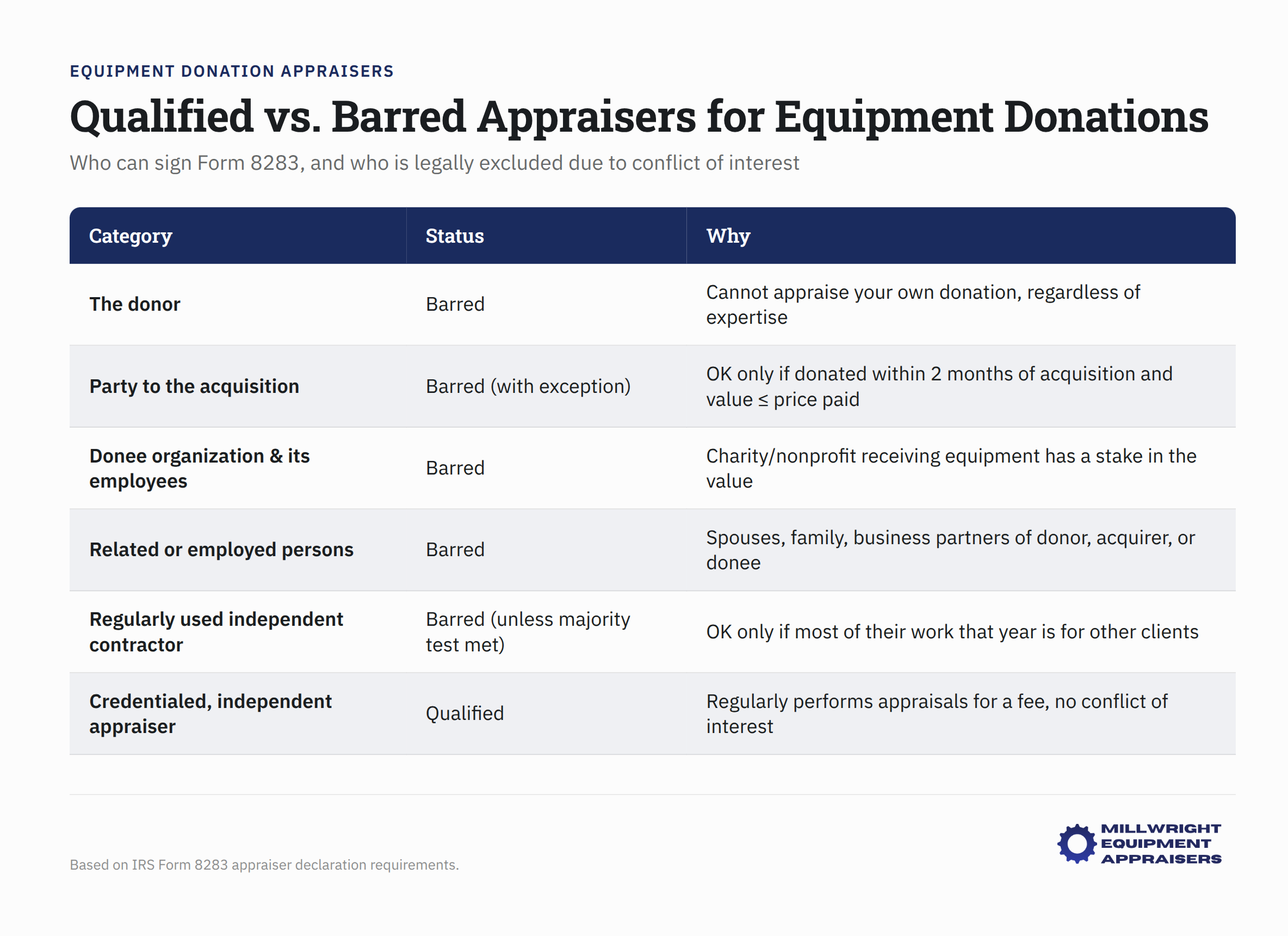
Even a fully credentialed appraiser cannot sign your Form 8283 if they have a conflict of interest with the transaction. The IRS excludes several categories of people outright, regardless of how many designations they hold:
- The donor. You cannot appraise your own donation, no matter how well you know the equipment's market value.
- A party to the transaction where you acquired the property, unless the equipment is donated within 2 months of when you acquired it and the appraised value does not exceed what you paid.
- The donee organization, meaning the charity or nonprofit receiving the equipment, and any employee of that organization.
- Anyone related to or employed by the donor, the acquisition party, or the donee, including spouses, family members, and business partners.
- An appraiser regularly used by the donor or donee as an independent contractor, unless that person performs the majority of their appraisal work for other clients during the tax year.
These exclusions exist to keep the valuation independent of anyone with a financial stake in the outcome. The IRS lists these barred parties directly in the appraiser declaration section of Form 8283, and a signature from any of them invalidates the appraisal for tax purposes even if the dollar figure is defensible.
Why the Equipment Dealer Who Sold You the Machine Can't Sign the Appraisal
This is the single most common mistake we see with equipment donations. A donor calls the dealer who sold them the machine three years ago, or the broker who handles their used equipment trade-ins, and asks for a signed appraisal. Neither can serve in that role, and the reason is structural, not a matter of trust.
A dealer or broker who was party to how you acquired the equipment is disqualified as a party to the acquisition transaction, unless the narrow 2-month, at-or-below-cost exception applies. Even a dealer who had nothing to do with your original purchase usually fails the independence test if they have an ongoing commercial relationship buying and selling the same category of machinery, since their opinion of value can be seen as self-interested. An in-house staff member, such as a fleet manager or maintenance director, fails for a simpler reason: they're effectively acting for the donor, not as an independent third party.
Watch out: Some donors assume a signed invoice or a dealer's trade-in quote can substitute for a qualified appraisal. It cannot. The IRS requires an independent, credentialed appraiser's opinion, not a sales document from someone with a stake in the transaction.
The $5,000 Threshold and Form 8283 Section B
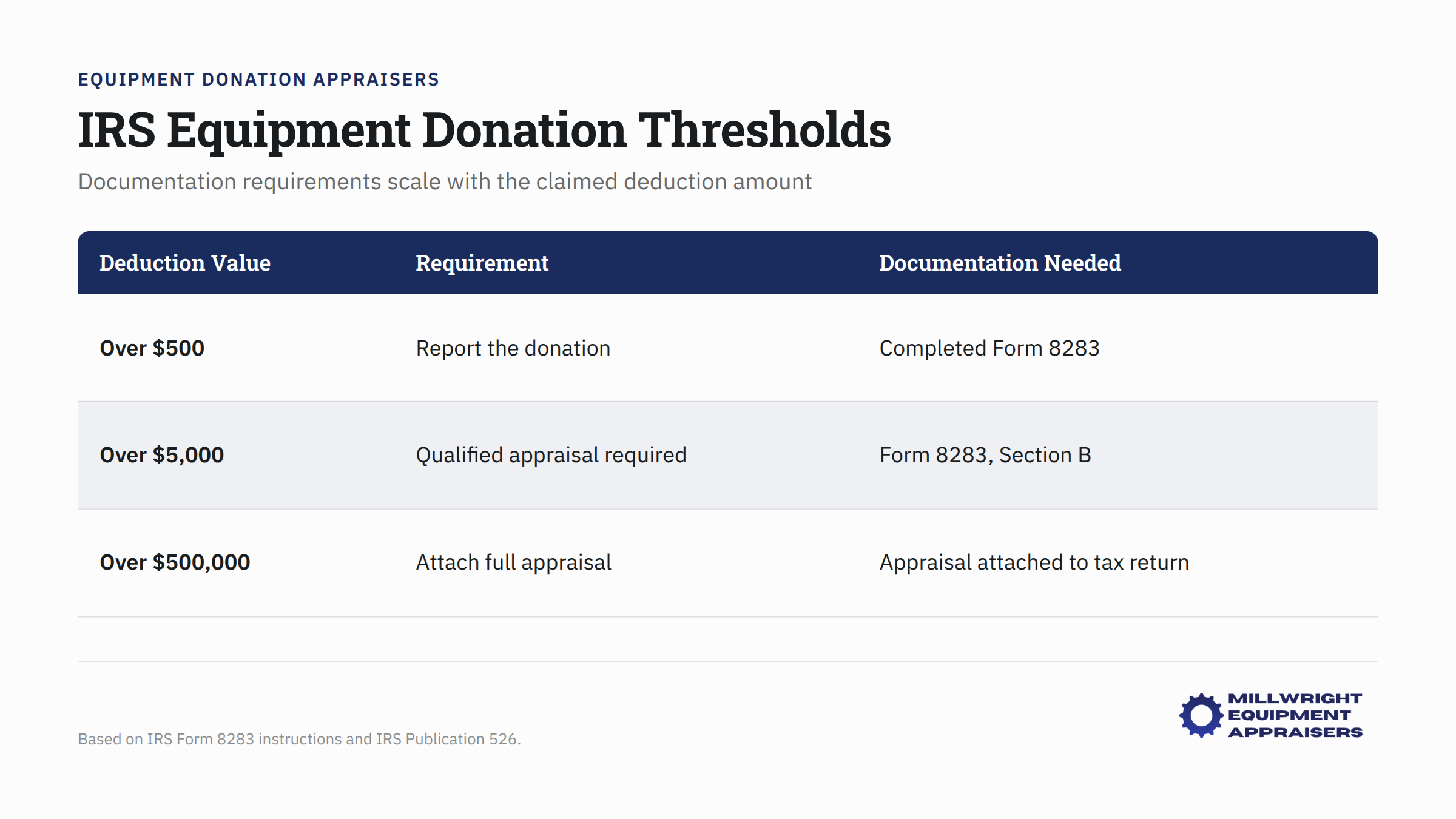
A qualified appraisal is required whenever the claimed deduction for donated equipment exceeds $5,000, and the appraisal must support the values reported in Form 8283, Section B. Below that threshold, a contemporaneous written acknowledgment from the charity and a completed Form 8283 are typically sufficient. Above $500,000, the full appraisal generally has to be attached to the return itself, according to IRS Publication 526.
The appraisal also has a timing window: it must be dated no earlier than 60 days before the contribution and completed by the filing deadline, including extensions, for the return on which the deduction is first claimed. Our step-by-step guide to completing Form 8283 walks through exactly how that documentation flows from the appraisal into the return.
USPAP Compliance and the Credentials That Matter for Equipment
Beyond the IRS's own qualification rules, the professional standard that governs how the appraisal is actually performed is the Uniform Standards of Professional Appraisal Practice (USPAP), published by The Appraisal Foundation. The Form 8283 instructions specifically point to USPAP as the framework a qualified appraisal should follow, covering how the appraiser documents condition, methodology, market data, and the reasoning behind the concluded value.
For machinery and equipment specifically, look for appraisers who hold credentials with organizations built around this asset class, such as the ASA, CAGA, or NEBB. These credentials signal that the appraiser has demonstrated competence in equipment valuation methodology specifically, rather than a general personal property background. Our appraisers hold credentials with organizations including the ASA, CAGA, and NEBB, and every report we prepare is built to be USPAP-compliant and structured for its intended IRS use.
Key takeaway: The person signing your equipment appraisal needs three things at once: documented equipment-specific expertise, a regular appraisal practice, and zero financial connection to how you acquired or are donating the machine. Missing any one of the three puts your deduction at risk.
If you're preparing to donate equipment and want to confirm your appraiser meets every part of this standard before you file, our team can scope your appraisal and walk through exactly what your Form 8283 will need.
This article is provided for general informational purposes only and does not constitute legal, tax, or financial advice. Readers should consult a qualified attorney or CPA regarding their specific circumstances.