
Blog
Do Multiple Small Equipment Donations Need One Appraisal or Several?
The IRS similar items aggregation rule means several sub-$5,000 equipment donations in one category can still trigger a qualified appraisal requirement. Here's how to tell what gets grouped, what stays separate, and what Form 8283 demands once you cross the line.
If you're donating a handful of tools, a few pieces of shop machinery, or a stack of old office electronics to the same charity, it's tempting to look at each item's price tag and assume you're in the clear because none of them tops $5,000 on its own. That assumption is where a lot of donors get tripped up. The IRS doesn't just look at each item in isolation; it has a similar items aggregation rule that can push a pile of modest donations over the qualified appraisal threshold even when no single piece comes close to it alone.
This matters because getting the threshold wrong doesn't just cost you paperwork. It can mean a disallowed deduction if the IRS later decides you needed a qualified appraisal and didn't get one. Our team prepares these reports regularly, and the aggregation question is one of the first things we walk clients through before any valuation work starts.
What Is the Similar Items Aggregation Rule?
The similar items aggregation rule requires donors to combine the value of multiple items of the same generic type when determining whether a donation exceeds the $5,000 qualified appraisal threshold, even if each individual item is worth less than $5,000. IRS Publication 561 addresses this directly in its section on deductions of more than $5,000, and the underlying Treasury regulation defines "similar items" as property of the same generic category or type.
For equipment donations, this plays out constantly. A donor giving away five used drill presses, a handful of hand tools, or a cluster of desktop computers isn't testing each item against $5,000 separately. The donor is testing the whole group against $5,000, because drill presses are drill presses, hand tools are hand tools, and computers are computers, regardless of how the donation gets split up on paper.
Why the IRS Aggregates Similar Items
The policy logic is straightforward: without an aggregation rule, a donor could avoid the appraisal requirement entirely by donating ten $1,000 pieces of equipment instead of one $10,000 piece. The Treasury regulation governing qualified appraisals closes that gap by treating a group of similar items contributed in the same tax year as a single unit for threshold purposes, while still only requiring one appraisal to cover the whole group.
What Counts as "Similar" Equipment?
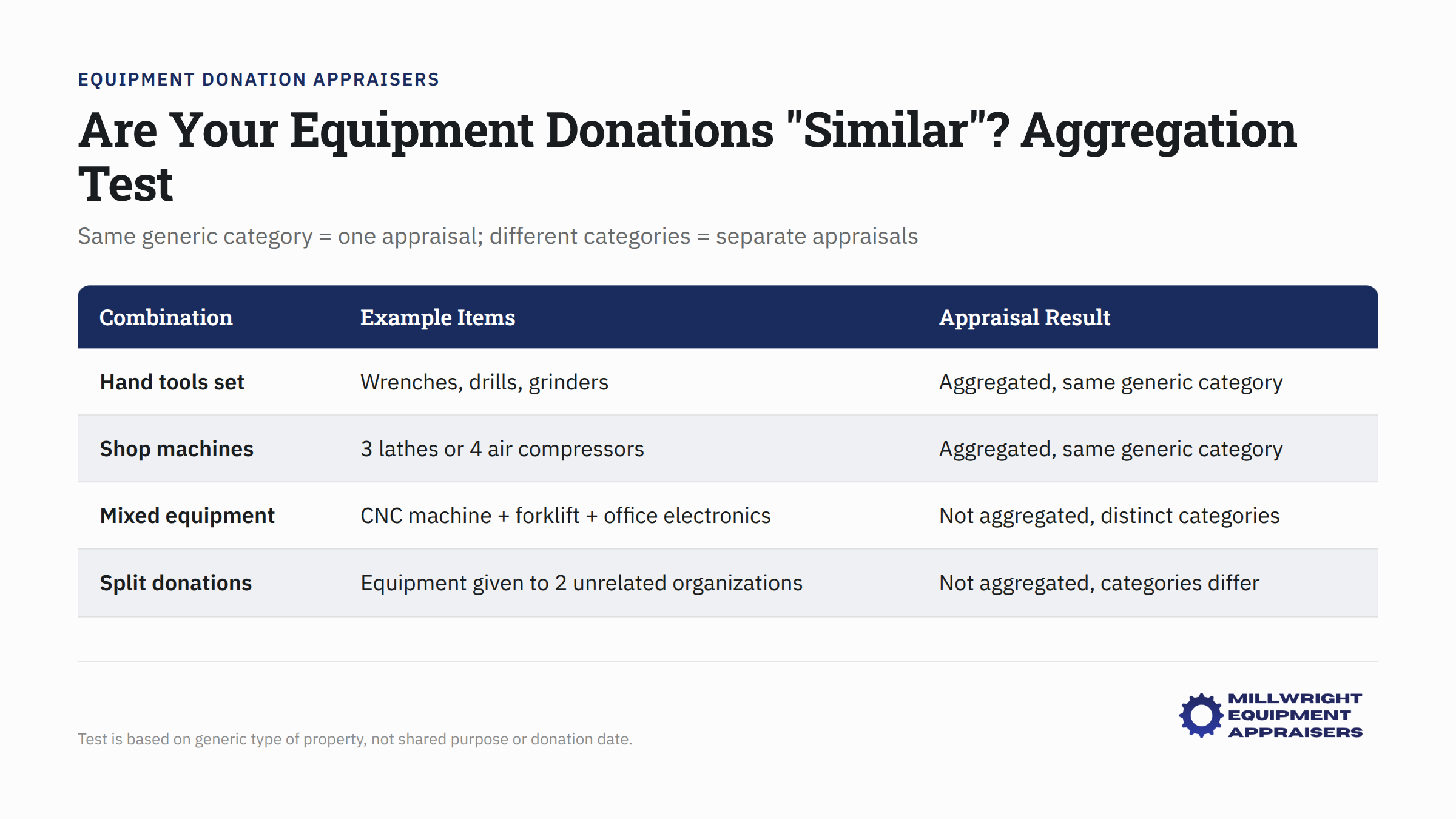
Two items count as similar when they belong to the same generic category or type of property, not merely when they serve the same business or were donated on the same day. A welder, a forklift, and a bank of office computers are not similar to each other even though they might all sit in the same warehouse and get donated in the same box of paperwork.
Here's how that plays out with typical equipment categories:
- Aggregated together: several comparable hand tools (wrenches, drills, grinders) donated as a set
- Aggregated together: multiple shop machines of the same generic type, such as three used lathes or four air compressors
- Not aggregated: a CNC machine donated alongside a forklift and a set of office electronics, since each belongs to a distinct generic category
- Not aggregated: equipment donated to two unrelated organizations where the categories themselves differ
The test is generic type, not shared purpose or shared delivery date. A welder and a forklift might both be "shop equipment" in casual conversation, but for appraisal purposes they're different categories and get evaluated independently.
Same Donee, Same Date, or Spread Out: Does It Change the Rule?
Aggregation applies to similar items contributed in the same tax year, and this holds whether the equipment goes to one charity on one date or gets split across several donees over several months. The Form 8283 instructions are explicit that a donor must count all items in a similar group, even when the items go to more than one donee organization.
What changes with multiple donees isn't whether aggregation applies, it's how the reporting gets handled. The appraisal itself can still cover the entire group of similar items as long as it includes all the required information for each one, but the donor generally needs a separate Form 8283 for each donee once the total deduction to that recipient exceeds $5,000.
Watch out: Donors sometimes assume that spreading similar equipment across a few different nonprofits resets the threshold. It doesn't. The IRS instructions are built specifically to prevent that workaround.
When Does Form 8283 Section B Kick In?
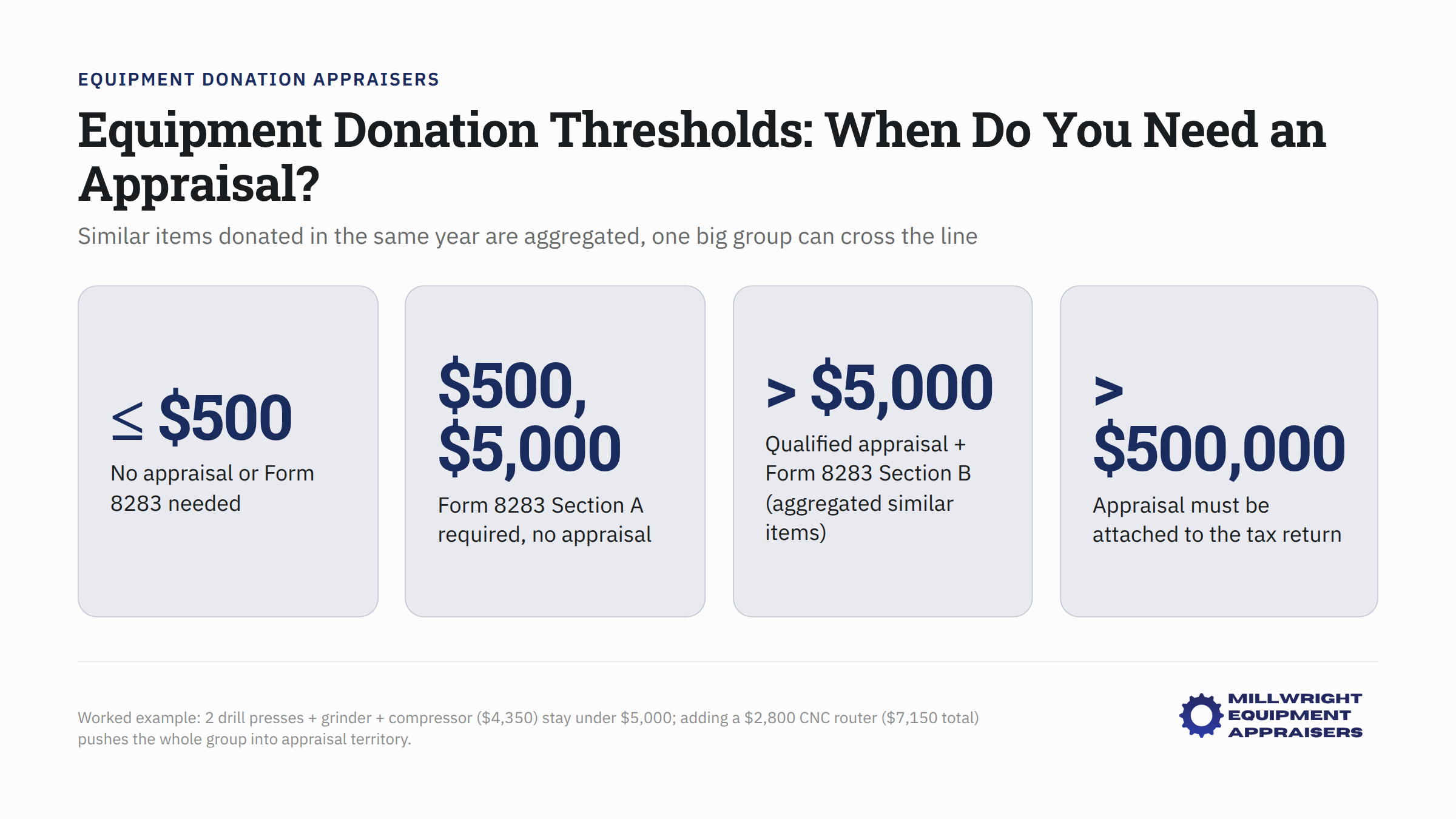
Once the aggregated value of similar equipment items exceeds $5,000, the donor must complete Form 8283, Section B, and the appraisal must be a qualified appraisal signed by a qualified appraiser. Below $5,000, Section A generally applies and no appraisal is required.
The practical breakpoints look like this:
- $500 or less: no appraisal and minimal Form 8283 reporting required
- More than $500 but not more than $5,000 (per item or similar group): Form 8283 Section A is generally required; a qualified appraisal is generally not
- More than $5,000 (per item or similar group): a qualified appraisal is required, and Form 8283 Section B must be completed with the appraiser's signature
- More than $500,000 in claimed noncash property: the qualified appraisal itself generally must be attached to the return
For more on what a qualified appraisal needs to contain and who's permitted to sign one, our guide to completing Form 8283 walks through the form section by section.
Worked Example: Five Pieces of Shop Equipment
Suppose a manufacturing business decides to donate a batch of surplus equipment to a vocational training nonprofit in the same tax year. Here's what gets donated and its estimated fair market value:
| Item | Fair Market Value |
|---|---|
| Used drill press | $1,400 |
| Used drill press (second unit) | $1,200 |
| Bench grinder | $650 |
| Air compressor | $1,100 |
| Desktop computer with monitor | $450 |
At first glance, every single item sits comfortably under $5,000. No appraisal needed, right? Not quite.
Group the similar items first. The two drill presses, the bench grinder, and the air compressor are all generic shop machinery, the kind of equipment a metalworking or general fabrication shop would use. Grouped together, that's $1,400 + $1,200 + $650 + $1,100 = $4,350. Still under $5,000, so this group falls into the Section A range and doesn't need a qualified appraisal.
Now consider the computer separately. A desktop computer is a different generic category from shop machinery (it's electronic equipment, not fabrication equipment), so it isn't aggregated with the machine tools. At $450, it's well under the $500 Section A threshold on its own.
Example: Now change one fact. Add a used CNC router valued at $2,800 to the same donation, in the same generic shop-machinery category as the other four items. The group total becomes $4,350 + $2,800 = $7,150. That crosses $5,000, which means the entire group of similar machinery, not just the CNC router, now requires a single qualified appraisal and a Form 8283 Section B signature. The desktop computer still stands alone and still doesn't need one.
This is the exact scenario where donors get caught off guard. Adding one more similar item to an existing batch doesn't just affect that item's own tax treatment; it can pull the whole group across the line.
Documentation That Supports the Aggregate
Even when one qualified appraisal covers a whole group of similar equipment, the IRS still expects item-level detail inside that report. Publication 561 describes fair market value as the price a willing buyer and willing seller would agree to, with neither under pressure and both reasonably informed, and that standard has to be applied to each item in the group, not estimated as a lump sum.
Pro tip: Keep a running list of everything donated in a given tax year within the same equipment category, even if individual pieces are given away on different dates. That list is what your appraiser needs to determine whether the group as a whole has crossed the $5,000 line, and it's exactly what an IRS reviewer will ask for if the deduction gets questioned.
Key takeaway: The question isn't whether any single piece of equipment is worth more than $5,000. It's whether the generic category of equipment you donated, added up across the tax year, crosses that threshold. Get the grouping right before you file, not after.
Organizations such as the International Society of Appraisers and the American Society of Appraisers train appraisers on exactly this kind of threshold analysis, and reports prepared in accordance with USPAP (the Uniform Standards of Professional Appraisal Practice) are built to hold up to the scrutiny an aggregated equipment donation can attract.
Getting the Grouping Right Before You File
Misjudging the similar items aggregation rule is one of the most common ways equipment donors end up without the documentation they need. If you're donating more than one piece of equipment in the same category this year, even if every item looks small on its own, it's worth having the group evaluated together before you claim the deduction. Our team can scope and prepare your appraisal so your Form 8283 reporting matches what the aggregate actually requires.
This article is provided for general informational purposes only and does not constitute legal, tax, or financial advice. Readers should consult a qualified attorney or CPA regarding their specific circumstances.