
Blog
Why a USPAP-Compliant Equipment Donation Appraisal Protects You in an IRS Audit
A USPAP-compliant equipment donation appraisal gives your deduction the documentation the IRS actually looks for, not just a number. Here's what compliance requires, how it differs from a trade-in quote, and what an audit can cost you without it.
When you donate equipment worth more than $5,000 and claim the deduction, the IRS doesn't just want a value. It wants proof that the value was developed the right way, by the right person, in the right format. A USPAP-compliant equipment donation appraisal is the document that supplies that proof. Skip it, or substitute something that looks similar but isn't, and you're carrying real audit risk on a deduction you may have already spent.
This matters most for the donors who assume any written estimate will do. It won't. The IRS's own rules for qualified appraisals point directly back to recognized professional appraisal standards, and our equipment donation appraisal service exists specifically to produce reports that meet them.
What "USPAP-Compliant" Actually Means for an Equipment Donation Appraisal
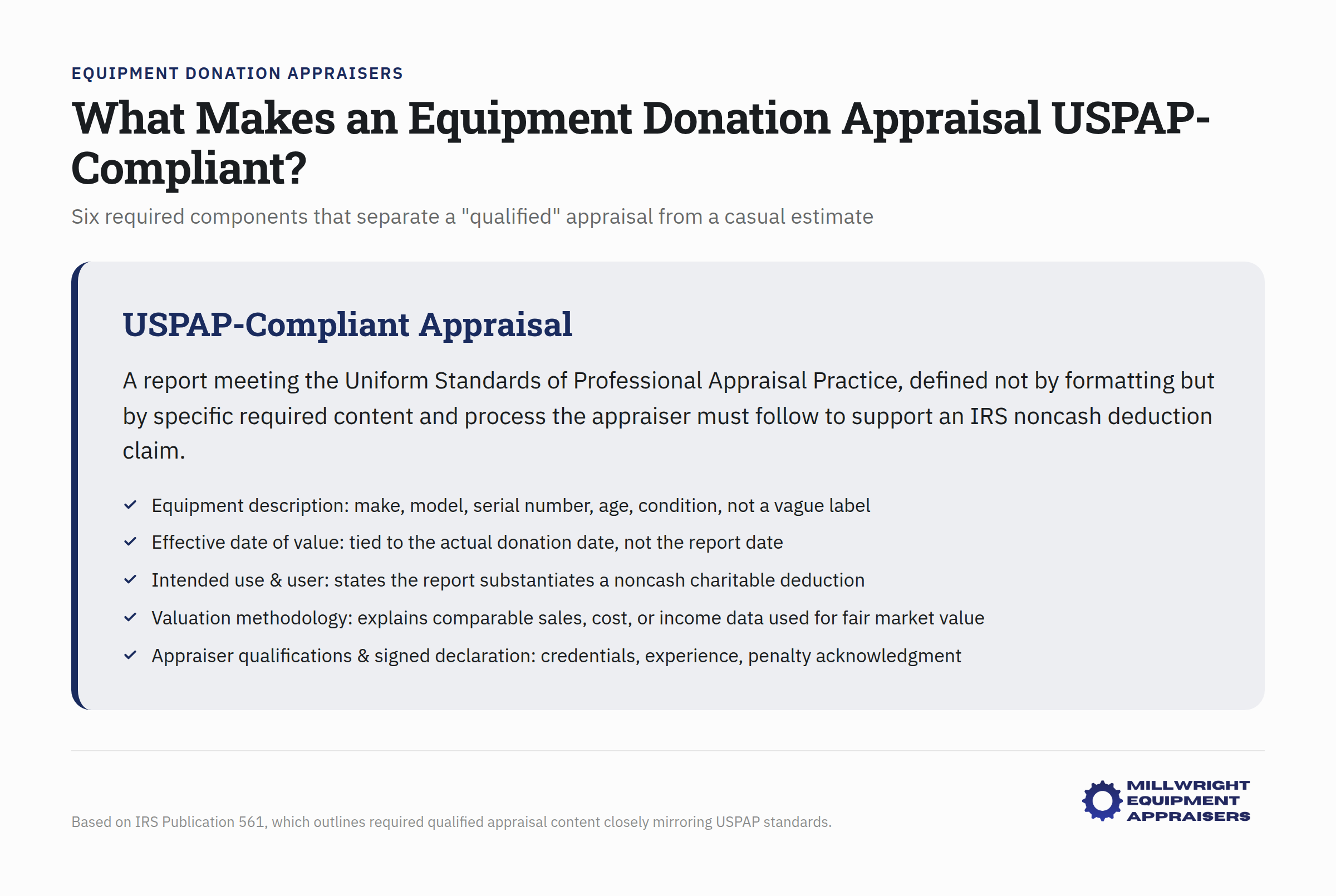
USPAP (the Uniform Standards of Professional Appraisal Practice) is the set of ethical and reporting standards published by The Appraisal Foundation. A compliant equipment appraisal isn't defined by a fancier cover page. It's defined by specific content the report has to contain and a process the appraiser has to follow.
At minimum, a USPAP-compliant equipment donation appraisal includes:
- A description of the equipment detailed enough to identify each item: make, model, serial number, age, and condition, not a vague category label.
- The effective date of value, tied to the date of donation, not the date the report was written.
- The intended use and intended user stated explicitly (in this case, substantiating a noncash charitable deduction on a federal tax return).
- The valuation approach and methodology, including how comparable sales, cost data, or income data were analyzed to reach a fair market value conclusion.
- The appraiser's qualifications, including credentials, relevant experience with the specific type of equipment, and a signed certification.
- A signed appraiser's declaration acknowledging the penalties for a substantial or gross valuation misstatement.
IRS Publication 561 lays out the specific information a qualified appraisal must include, and it maps closely to these USPAP components, from the appraiser's background to the valuation method used to reach the number (IRS Publication 561). The overlap isn't a coincidence. It's the reason USPAP compliance functions as the practical test of whether an appraisal is "qualified."
Why the IRS Points Back to USPAP: Qualified Appraisals and Qualified Appraisers
The IRS doesn't publish its own separate valuation methodology for donated property. Instead, it defines a "qualified appraisal" and a "qualified appraiser" and then relies on established professional standards to fill in what that actually looks like in practice. This is the core of USPAP appraisal requirements as they apply to charitable donations: the appraisal must be prepared by someone with verifiable credentials or demonstrable expertise, and it must be built the way a professional appraisal is supposed to be built.
The Appraisal Foundation has stated that the IRS's final rule on charitable-contribution appraisals cites the substance and principles of USPAP for all property types, equipment included (The Appraisal Foundation). The instructions to Form 8283 reinforce the same idea from the appraiser side: a qualified appraiser generally holds a recognized appraisal designation or has otherwise met minimum education and experience requirements, and must not be the donor, the donee, or someone with a financial stake in the transaction (IRS Form 8283 Instructions).
For a step-by-step walkthrough of how that appraisal gets attached to your actual tax filing, our guide to completing IRS Form 8283 covers the form itself in detail.
Pro tip: Credentials alone don't make an appraisal compliant. An appraiser who holds a designation from the American Society of Appraisers, the International Society of Appraisers, or a similar organization still has to follow USPAP's development and reporting rules on every individual assignment. The credential establishes eligibility; the report itself has to do the work.
How a Compliant Report Differs from a Trade-In Quote or an Online Estimate
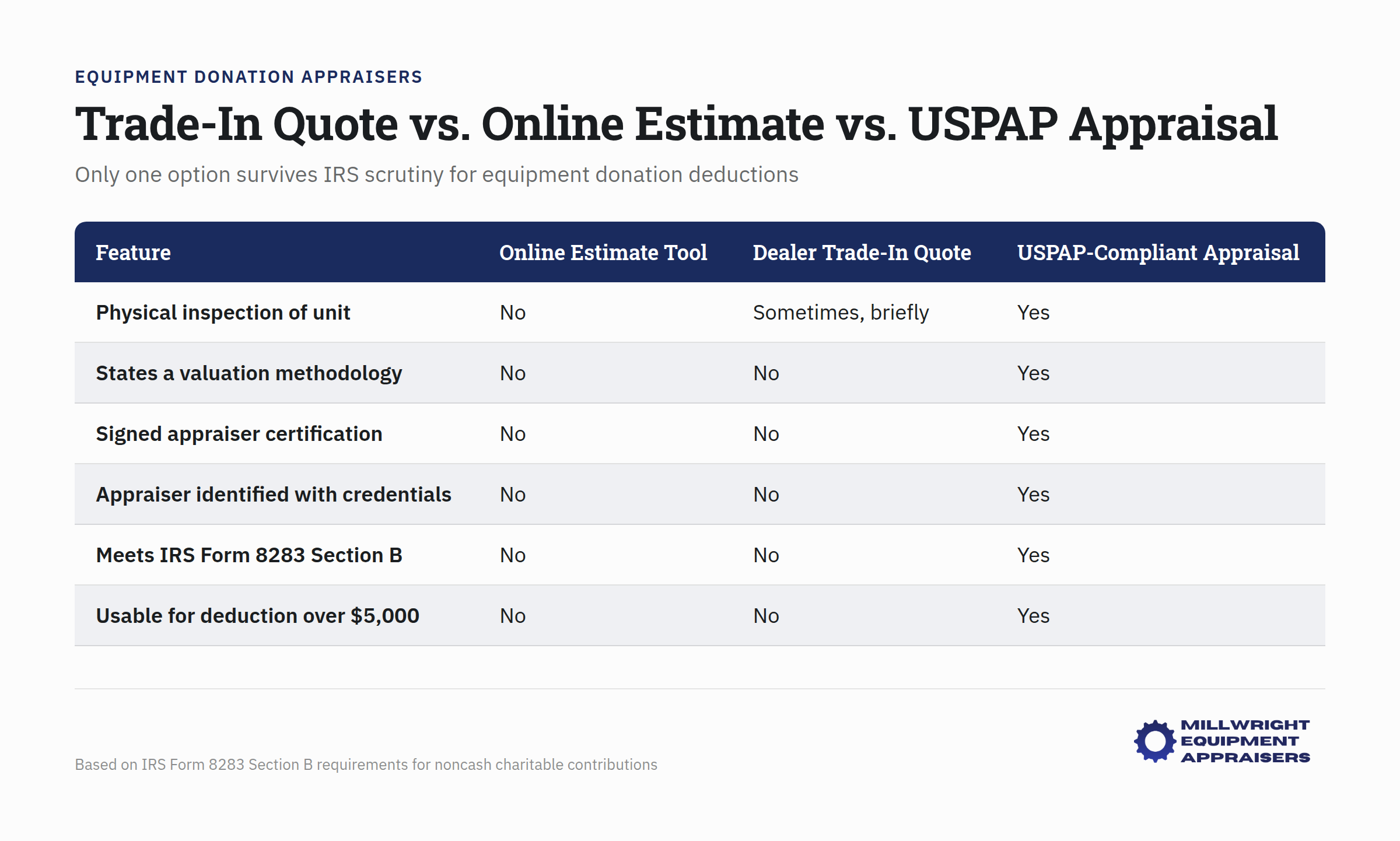
A USPAP-compliant appraisal and an online value estimate can both produce a dollar figure, but only one of them will survive IRS scrutiny. The difference isn't cosmetic. It's the presence or absence of a documented, defensible valuation process.
A dealer trade-in quote reflects what a dealer is willing to pay toward a new purchase, a number that's deliberately conservative and shaped by the dealer's own margin needs, not fair market value between a willing buyer and willing seller. An online estimate tool applies a generic depreciation curve to a make and model, with no inspection of the specific unit's condition, hours, or modifications. Neither one states a methodology, identifies the appraiser, or comes with a signed certification. For a closer look at how fair market value is actually calculated versus what these shortcuts produce, see our guide on fair market value versus replacement cost for donated equipment.
| Feature | Online Estimate Tool | Dealer Trade-In Quote | USPAP-Compliant Appraisal |
|---|---|---|---|
| Physical inspection of the specific unit | No | Sometimes, briefly | Yes |
| States a valuation methodology | No | No | Yes |
| Signed appraiser certification | No | No | Yes |
| Appraiser identified with credentials | No | No | Yes |
| Meets IRS Form 8283 Section B requirements | No | No | Yes |
| Usable to support a deduction over $5,000 | No | No | Yes |
The Penalty Risk: IRC 6662 and Valuation Misstatements
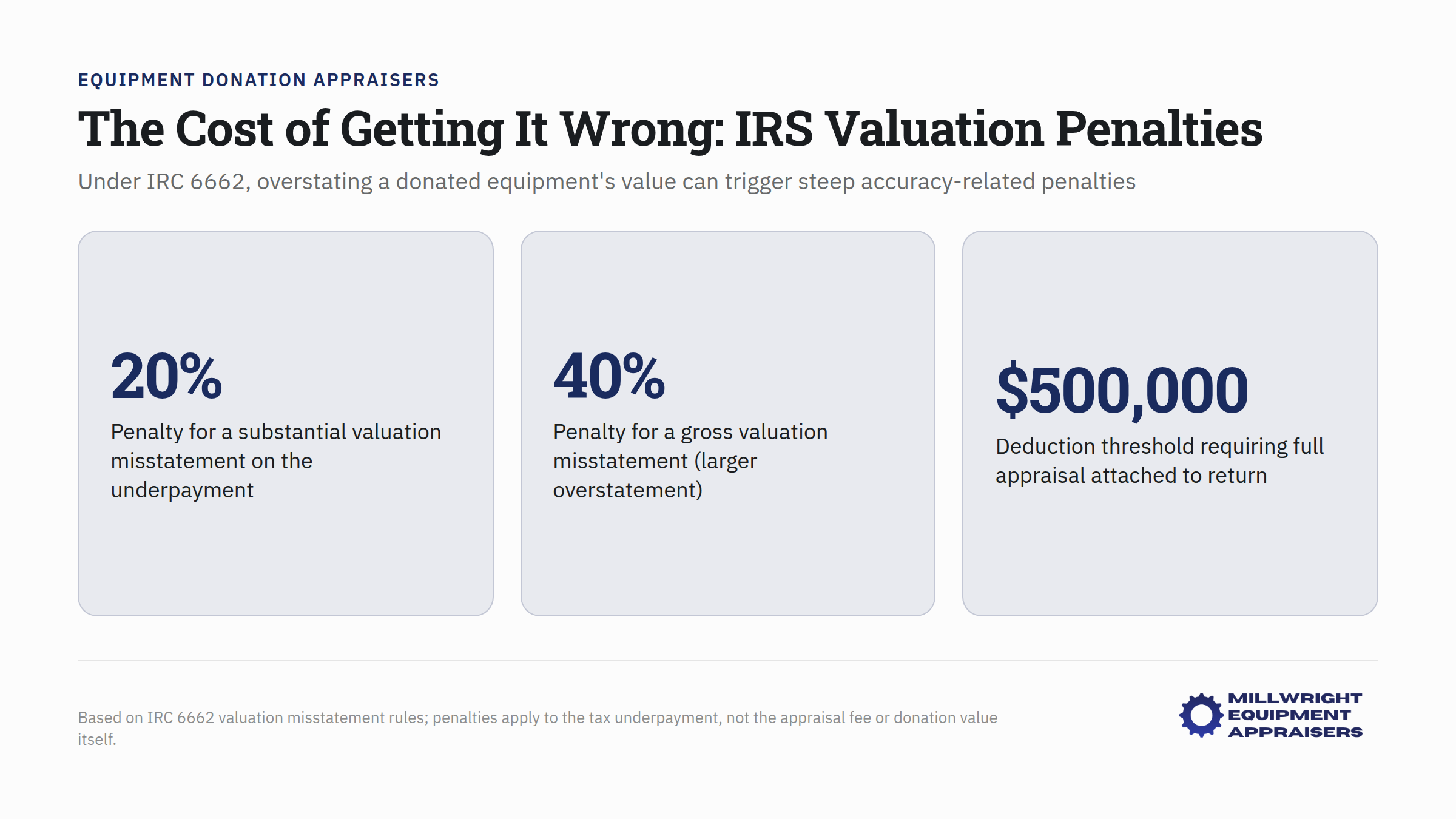
Overstating the value of donated equipment doesn't just risk a denied deduction. It can trigger an accuracy-related penalty on top of the additional tax owed. Under the Internal Revenue Code's valuation misstatement rules, a substantial valuation misstatement (generally when the claimed value is a significant multiple of the correct value) can carry a 20% penalty on the underpayment attributable to the overstatement. A gross valuation misstatement, where the overstatement is far larger, can push that penalty to 40%.
This is exactly why the appraiser's declaration on a qualified appraisal exists: it puts the appraiser's own credibility and potential penalty exposure on the line alongside the taxpayer's. An appraiser who cuts corners on methodology or inflates a value to please a client is taking on the same kind of risk the donor is. That mutual accountability is part of what makes a USPAP-compliant report meaningfully different from a favor from a friend who "knows equipment."
Watch out: These penalties apply to the underpayment of tax, not the appraisal fee or the donation itself. A donor who overstates a $50,000 tractor's value by claiming $90,000 isn't just losing the extra deduction; they're exposed to a penalty calculated on the resulting tax underpayment.
The $500,000 Threshold: When the Appraisal Must Be Attached to Your Return
For most donations over $5,000, you keep the qualified appraisal in your records and file a completed Form 8283 with your return, but you don't have to attach the full report itself. That changes once the claimed deduction for an item or group of similar items exceeds $500,000. At that point, the IRS's rules for noncash charitable contributions require attaching a copy of the complete, signed qualified appraisal to the return, not just the summary form (IRS Publication 526).
For a business donating a fleet of vehicles, a production line, or a large lot of industrial equipment, that $500,000 aggregation threshold can arrive faster than expected, since similar items are grouped together for the test. A compliant appraisal report is written to stand on its own as an attachment: identified property, stated methodology, signed certification, and all, because at that dollar level, it may end up in front of an IRS reviewer directly rather than sitting in a file.
What a USPAP-Compliant Equipment Appraisal Costs
Fees for an IRS-qualified equipment appraisal are quoted as a fixed fee after we scope the assignment, never billed hourly. Scope is driven by how many items are involved, how complete the existing records are, and the depth of analysis the intended use requires, not by the value of the equipment itself.
For machinery and equipment appraisals prepared to IRS-qualified standard, fixed fees for our IRS-qualified engagements typically start from $395, with most straightforward assignments falling in the $695 to $3,000 range. Larger fleets, specialized industrial equipment, or multi-location inventories can run from $5,000 to $10,000 or more, reflecting the additional inspection and documentation work involved, not a higher equipment value.
Protecting Your Deduction Before You File
A USPAP-compliant appraisal is the difference between a deduction you can defend and one you're hoping nobody looks at too closely. The report needs a detailed description of the equipment, a stated valuation methodology, a signed appraiser certification, and credentials that hold up if the IRS asks. None of that comes from a trade-in quote or a five-minute online estimate, and the penalty exposure under a substantial or gross valuation misstatement makes the gap worth taking seriously.
If you're donating equipment worth more than $5,000, whether it's a single piece of machinery or a fleet being retired at once, get the appraisal built to the standard the IRS is actually checking against. Request an appraisal and our team will scope the assignment and quote a fixed fee before any work begins. For more on the standards and documentation behind equipment donation valuations, see our collection of equipment donation guides.
This article is provided for general informational purposes only and does not constitute legal, tax, or financial advice. Readers should consult a qualified attorney or CPA regarding their specific circumstances.